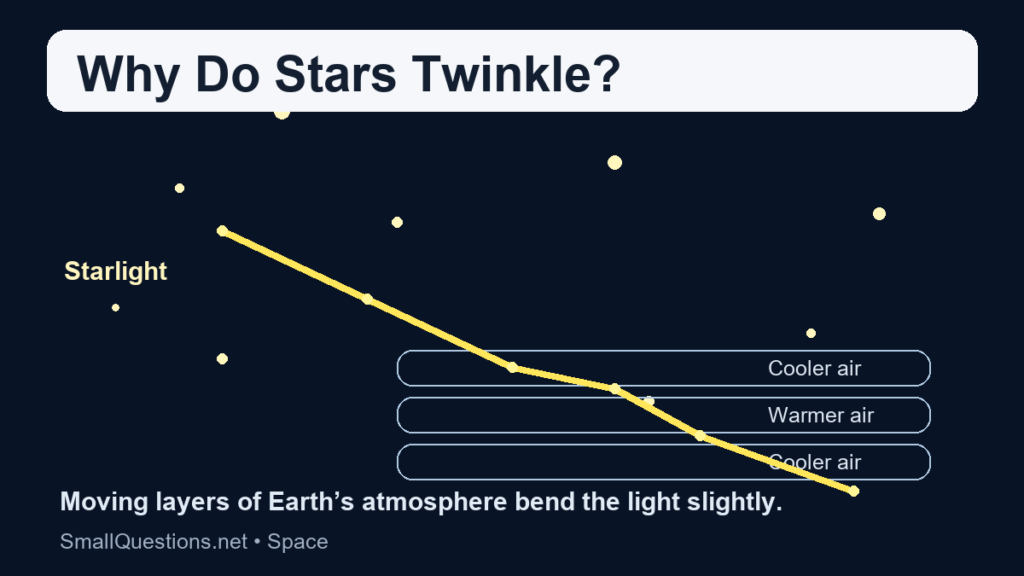
Why do stars twinkle? Stars appear to twinkle because their light passes through moving layers of Earth’s atmosphere before it reaches your eyes. Those layers have slightly different temperatures and densities, so they bend the starlight by changing amounts. The result is a rapid flicker in brightness and position that looks like twinkling.
Table of Contents
Why Do Stars Twinkle?
The stars themselves are usually shining steadily. The twinkle is created much closer to home, inside Earth’s atmosphere.
NASA explains that starlight is bent slightly as it passes through moving air. Because stars are so far away, they look like tiny points of light. Small changes in the path of that light can make a star appear to get brighter, dimmer, or shift a little from side to side.
Astronomers call this effect atmospheric scintillation. “Scintillation” is simply a technical word for the rapid changes in apparent brightness that we see as twinkling.
How Earth’s Atmosphere Makes Stars Twinkle
Air is not perfectly still or uniform. Different layers can have different temperatures, pressures, humidities, and densities. When light moves from one layer into another, its path can bend slightly. This bending is called refraction.
As the air moves, the exact path of the starlight keeps changing. One moment, a little more light is bent toward your eyes. The next moment, a little less reaches you. Because these changes happen quickly, the star seems to flicker.
NASA’s Imagine the Universe describes the atmosphere as being full of turbulent cells with slightly different properties. Those cells move through the line of sight, continuously changing how the point-like image of a star reaches us.
Why Stars Twinkle More Near the Horizon
A star near the horizon often twinkles more strongly than a star high overhead. The reason is simple: its light has to travel through more of Earth’s atmosphere before reaching you.
The longer atmospheric path gives the light more chances to be bent and disturbed by moving air. That can make stars near the horizon shimmer more dramatically and sometimes appear to flash different colors.
NASA’s StarChild notes that this extra amount of atmosphere is why stars low in the sky usually twinkle more than stars that are higher above the horizon.
Why Planets Usually Do Not Twinkle as Much
Planets can twinkle a little, especially when they are low in the sky, but they usually look steadier than stars.
That is because a planet is close enough to appear as a tiny disk rather than a perfect point of light. Light from different parts of that disk passes through slightly different parts of the atmosphere. The small changes tend to average one another out, so the planet looks steadier.
A distant star is much more point-like. If its narrow-looking beam is bent, the whole image can seem to jump or change brightness at once.
Why Twinkling Stars Can Change Color
You may sometimes notice a bright star flashing red, blue, green, or white. The atmosphere can separate and bend different wavelengths of light by slightly different amounts, especially when a star is low in the sky.
That color-shifting effect is easiest to notice in bright stars close to the horizon, where their light is passing through the greatest amount of air.
The star itself is not rapidly changing color. The colorful flicker is another effect of viewing a distant point of light through a moving atmosphere.
Do Stars Twinkle in Space?
No—not for the same atmospheric reason. Above Earth’s atmosphere, there are no moving layers of air to bend the light on its way to an observer.
That is one reason space telescopes can produce such sharp images. They do not have to look through the same turbulent atmosphere that blurs and twinkles stars for observers on the ground.
Ground-based observatories can reduce this problem with a technique called adaptive optics. Some telescopes measure the atmospheric distortion and rapidly adjust mirrors to help sharpen the image.
Does Twinkling Mean a Star Is Dying?
Usually, no. Ordinary twinkling is caused by Earth’s atmosphere and does not mean the star is changing dramatically or about to disappear.
Stars can genuinely vary in brightness over longer periods for many astronomical reasons, but the quick flicker you notice from second to second is usually atmospheric scintillation.
Frequently Asked Questions
Why do stars twinkle but the Moon does not?
The Moon appears as a large disk rather than a tiny point. Light from many parts of that disk passes through different parts of the atmosphere, so the small distortions average out. For more about our nearest large object in the night sky, read What is the Moon? and Why does the Moon shine?.
Does the Sun twinkle?
The Sun can shimmer when viewed through unstable air, especially near the horizon, but it does not normally look like a twinkling star because it appears as a large disk in our sky. You can learn more in What is the Sun?.
What is the scientific word for star twinkling?
The usual term is atmospheric scintillation. It refers to rapid changes in the apparent brightness or position of a distant point-like source caused by Earth’s atmosphere.
The Short Answer
Why do stars twinkle? They appear to twinkle because their light passes through moving layers of Earth’s atmosphere. Slight changes in temperature and density bend the light in constantly changing ways, making the star seem to flicker. Stars near the horizon often twinkle more because their light travels through more atmosphere.