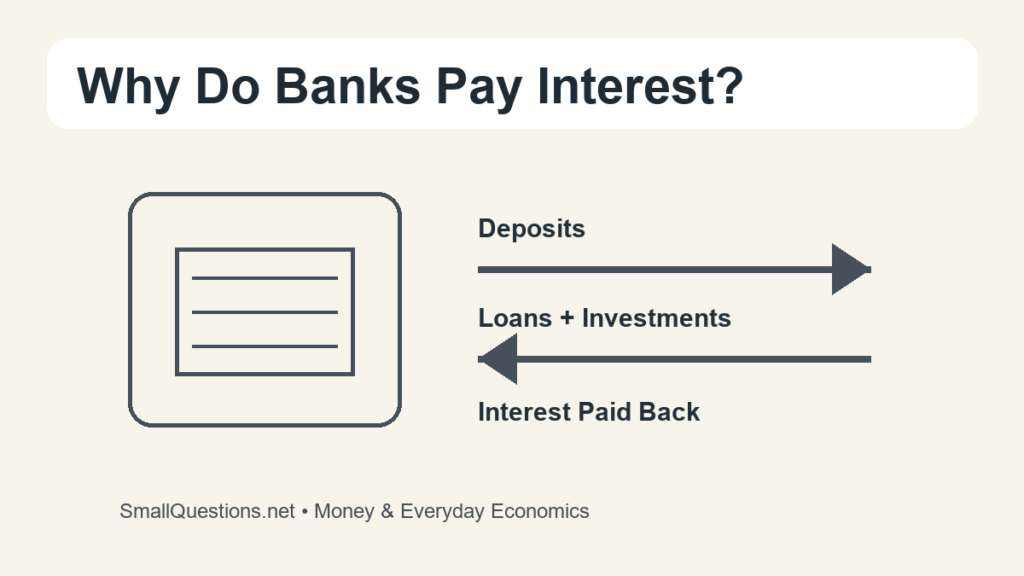
Why do banks pay interest? Banks pay interest because deposits are valuable funding. If you are wondering why do banks pay interest on money that seems to just sit in an account, the answer starts with how useful deposits are to a bank. When you leave money in a savings account, money market account, or certificate of deposit, the bank can use part of that deposit base to fund loans and investments. Interest is one way the bank competes for your money and encourages you to keep it there.
Table of Contents
Why Do Banks Pay Interest? The Short Answer
Banks pay interest because your deposits help fund the bank. Deposits are an important source of money that banks can use to make loans and investments. By paying interest, a bank can attract deposits, keep customers from moving their money elsewhere, and compete with other banks and credit unions.
That does not mean the bank simply hands your exact dollars to one borrower. Modern banking is more complicated, and banks must manage liquidity, reserves, capital, and risk. But the basic idea is simple: deposits have value to a bank, so the bank may pay you for providing them.
What Does a Bank Do With Your Deposit?
When you deposit money, the bank records that it owes that money back to you under the terms of your account. At the same time, deposits become part of the bank’s funding base.
The Federal Reserve’s bank supervision materials explain that deposits are a primary funding source for many banks and that banks use deposits mainly to fund loans and investments. That funding is one reason banks care about attracting and retaining deposits.
For example, a bank may collect deposits from thousands of customers and then make mortgages, auto loans, business loans, or other investments. The bank earns income from those activities while also paying operating costs, covering losses, meeting regulatory requirements, and paying depositors interest where applicable.
Why Do Banks Pay Interest on Savings?
Why do banks pay interest? The simplest answer is competition. If one bank offers nothing on savings while another offers a better rate with similar terms, some customers may move their money.
Paying interest can help a bank:
- attract new deposits;
- keep existing deposits from leaving;
- build a steadier source of funding;
- compete with other banks, credit unions, and money-market products;
- encourage customers to keep money deposited for longer periods.
The FDIC describes the basic relationship in consumer education materials: banks can pay interest because deposited money helps support lending activity, while the bank earns interest on loans.
How Can Banks Pay You and Still Make Money?
A bank generally tries to earn more on its assets than it pays on its funding and other expenses. One important part of banking is the difference between the yield a bank earns on loans and investments and what it pays for deposits and other funding.
Imagine a simplified example. A bank pays customers an average of 3% on certain deposits but earns a higher average return on a portfolio of loans. The difference is not pure profit because the bank still has salaries, buildings, technology, deposit insurance costs, loan losses, taxes, compliance expenses, and other obligations. But that spread helps explain how paying deposit interest can still make business sense.
The exact numbers vary by bank and change over time. Banks also earn money in other ways, including fees and services.
Why Do Savings Rates Change?
Savings rates do not stay fixed forever. They are influenced by market interest rates, competition, the bank’s need for deposits, and Federal Reserve policy.
When broad market rates rise, banks may offer higher deposit rates to attract funding. When rates fall or a bank already has plenty of deposits, it may not need to offer as much.
The Federal Reserve influences short-term interest rates through monetary policy. Changes in the federal funds target range can ripple through financial markets and affect what banks can earn and what they are willing to pay depositors.
That connection is covered in more detail in Why Do Interest Rates Go Up? If inflation is part of what is pushing rates higher, see Why Does Inflation Happen?
Why Do Some Accounts Pay More Interest Than Others?
Different accounts give banks different amounts of flexibility and stability, so they can pay different rates.
Savings accounts often pay interest because customers usually leave some money in place rather than using the account for constant daily spending.
Certificates of deposit (CDs) can pay more because you generally agree to leave the money deposited for a set term. The CFPB notes that withdrawing from a CD early can result in a penalty.
Money market deposit accounts may also pay interest, sometimes at rates that vary with the balance or market conditions.
Checking accounts are built for frequent transactions. Some pay interest, but many pay little or none because their main selling point is convenience rather than yield.
Why Do Many Checking Accounts Pay Little or No Interest?
Checking accounts are designed for spending: debit-card purchases, bill payments, checks, transfers, and ATM withdrawals. Banks often provide those transaction services instead of competing mainly on interest.
The Consumer Financial Protection Bureau notes that interest-bearing checking accounts do exist, but they may come with higher fees or balance requirements. That means a higher stated rate does not automatically make an account a better deal.
For consumers, the useful comparison is not just the interest rate. Fees, minimum balances, access, insurance coverage, and account rules all matter.
If the Bank Uses Deposits, Is Your Money Still Available?
Usually, yes. A bank is required to honor withdrawals according to the terms of the account. Banks therefore manage liquidity so they can meet normal customer withdrawal needs while also using deposits as a funding source.
At an FDIC-insured bank, eligible deposits are insured up to applicable legal limits if the bank fails. The CFPB notes that FDIC insurance generally protects eligible deposits up to $250,000 per depositor, per insured bank, for each account ownership category.
That insurance protection is different from investment performance. A savings account is a deposit product, not the same thing as buying a stock or mutual fund.
Why Doesn’t a Bank Pay Depositors the Same Rate It Charges Borrowers?
Because the difference helps cover the costs and risks of operating the bank. A lending rate has to account for the chance of default, administrative costs, capital requirements, servicing, and other expenses.
The bank also has to maintain enough liquidity to serve depositors who may want their money back. So the rate paid on savings is normally lower than the rate charged on many loans.
Why Would a Bank Suddenly Offer a Very High Savings Rate?
A bank may want more deposits quickly, be competing aggressively for customers, or be promoting a particular account. Online banks may also have lower branch costs and choose to pass some of that difference to depositors through higher rates.
But a high rate should be read together with the account terms. Check whether the rate is promotional, whether it applies only up to a certain balance, whether a minimum deposit is required, and whether fees could offset the interest.
What Does APY Mean?
APY stands for annual percentage yield. It is designed to show how much an account can earn over a year while taking compounding into account.
The CFPB explains that compound interest means earning interest on both the original principal and interest that has already been credited. That makes APY a more useful comparison than looking only at a simple stated rate when accounts compound differently.
Frequently Asked Questions
Do banks pay interest on all deposits?
No. Many savings accounts, money market deposit accounts, and CDs pay interest. Some checking accounts do too, but others pay no interest.
Where does the money used to pay interest come from?
Ultimately, it comes from the bank’s overall business income. Banks earn money from loans, investments, fees, and other services, then pay expenses that can include interest paid to depositors.
Can a bank lower my savings rate?
For a variable-rate account, yes. Banks can change rates subject to the account agreement and applicable disclosure rules. Fixed-term products such as many CDs work differently because their rate is generally set for the term.
Why do online banks often pay more interest?
Some online banks have lower operating costs or may compete more aggressively for deposits. That can allow them to offer higher rates, although account terms still vary by institution.
Does a higher Federal Reserve rate guarantee a higher savings rate?
No. The Federal Reserve influences the overall rate environment, but each bank decides what it will pay based on funding needs, competition, strategy, and market conditions.
Is interest from a savings account free money?
It is money you earn for keeping funds on deposit, but it may be taxable income. Tax treatment depends on your circumstances, so tax questions are best checked against current IRS guidance or a qualified tax professional.
Why Do Banks Pay Interest? Bottom Line
Why do banks pay interest to savers? In practical terms, paying depositors can be cheaper and more dependable than relying entirely on other sources of funding.
Why do banks pay interest? Because deposits are valuable. They give banks a source of funding for lending and investing, and paying interest helps banks attract and retain that funding. The bank aims to earn enough from loans, investments, and services to cover the interest it pays, its operating costs, and its risks.
For depositors, the practical lesson is simple: banks compete for your money. Comparing APY, fees, minimum balances, access rules, and deposit insurance can help you understand what you are actually getting in return.