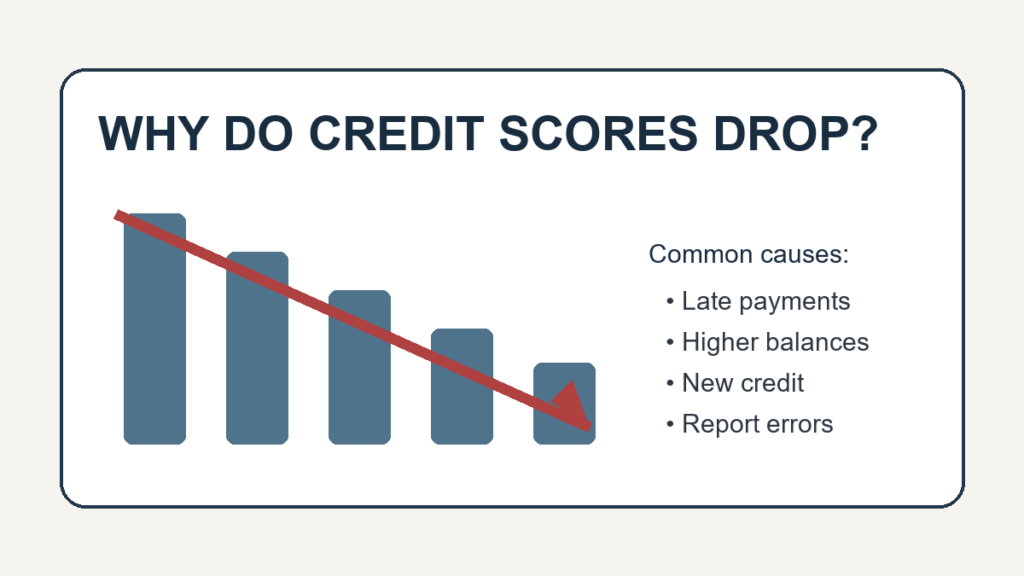
Why do credit scores drop? Usually because something in your credit report changed in a way a scoring model sees as higher risk. Common causes include a late payment, higher credit-card balances, a new hard inquiry or account, closing a credit card, or an error appearing on your credit report. A drop can also happen even when you did nothing obviously “wrong.”
Table of Contents
Why Do Credit Scores Drop? The Short Answer
Credit scores are calculated from information in your credit reports. The CFPB says scoring models typically consider payment history, unpaid debt, account types and ages, credit utilization, new applications, and serious negative events. Your score can therefore move whenever the underlying report changes.
There is also no single universal credit score. Different scoring models, credit bureaus, data and calculation dates can produce different numbers. That is one reason two services may show different scores at the same time.
1. A Late or Missed Payment Was Reported
Payment history is especially important. FICO says payment history accounts for 35% of a typical FICO Score calculation, although the effect of any event depends on the individual credit file. A recently reported late payment can therefore cause a noticeable drop.
The severity, recency and frequency of late payments matter. One late payment does not guarantee a particular point loss, and two people can experience different changes from similar events.
2. Your Credit Card Balances Increased
Credit scoring models look at how much revolving credit you are using compared with the credit available to you. If card balances rise—or your available limits fall—your utilization can increase.
FICO groups amounts owed at about 30% of a typical score calculation. The CFPB similarly advises consumers not to get too close to their credit limits. This can explain a score drop even when every payment was made on time.
3. You Applied for or Opened New Credit
A lender may make a hard inquiry when you apply for credit. The CFPB says hard inquiries can affect credit scores because scoring models consider how recently and frequently you apply. Checking your own credit report is a soft inquiry and does not lower your score.
A new account can affect more than the inquiry. FICO notes that it can reduce the average age of your accounts and, after you begin using the account, can change your amounts owed and utilization.
4. You Closed a Credit Card
Closing a card does not automatically improve your credit. The CFPB warns that closing a card can reduce your total available revolving credit. If your other balances stay the same, that can raise your utilization ratio and lower your score.
That does not mean you should keep every card forever. Fees, poor terms, fraud concerns and the temptation to overspend can all be valid reasons to close an account. The point is simply that closing one can have a scoring consequence.
5. You Paid Off a Loan
This one surprises people. Paying off debt is generally financially positive, but a score can sometimes move after an installment loan closes because the information in your credit file has changed. Credit mix and the status of active accounts are among the factors scoring models may consider.
A temporary score change after paying off a loan does not mean paying the debt was a mistake. Credit scores measure predicted credit risk; they are not a complete measure of your financial health.
6. Why Do Credit Scores Drop for “No Reason”?
If nothing obvious happened, the reason may simply be timing. Lenders report account information at different times. A larger-than-usual card balance might be reported before you pay the bill, a new account might appear, or an older piece of information may have changed status.
You may also be comparing different scores. The CFPB explains that scores can vary by scoring model, source of credit-report data and even the date calculated. So a number shown by one service is not necessarily the same score a lender sees.
7. Something on Your Credit Report Is Wrong
A credit-report error can also hurt a score. The CFPB recommends checking reports for accounts you do not recognize, payments incorrectly shown as late, closed accounts listed as open, and duplicate information.
If information is inaccurate, you can dispute it with the credit reporting company and the company that supplied the information. Keep documentation supporting the dispute.
Why Do Credit Scores Drop, and What Should You Do Next?
For related everyday-money questions, see Why Do Interest Rates Go Up? and Why Do Banks Pay Interest?
First, identify what changed rather than guessing. Review your credit reports, compare recent balances and limits, look for new inquiries or accounts, and check payment history. Checking your own report does not hurt your score.
Then address the underlying cause. Bring late accounts current, continue paying on time, reduce high revolving balances when practical, avoid unnecessary new applications, and dispute inaccurate information. A score may change again as lenders update the bureaus and new information replaces older data.
There is no guaranteed number of points or recovery timetable. FICO notes that the same action can affect different credit profiles differently.
Frequently Asked Questions
Why did my credit score drop when I paid everything on time?
Payment history is only one factor. Higher utilization, a new account or inquiry, closing a card, changes in account age, or newly reported information can move a score even with perfect recent payments.
Does checking my own credit score lower it?
No. The CFPB classifies your own review of your credit report as a soft inquiry, which does not affect your credit scores.
Why did my credit score drop after paying off a loan?
Closing an installment loan changes the mix and status of accounts in your credit file. A score can move as a result, but that does not make paying off debt financially harmful.
Can closing a credit card lower my score?
Yes. Closing a card can reduce available revolving credit and increase your utilization ratio, depending on your other balances and limits.
Can my score drop because of an error?
Yes. Incorrect late payments, unfamiliar accounts, duplicate entries and other reporting errors can affect the information used by scoring models. Review your reports and dispute inaccurate items.
Why are my credit scores different?
Different bureaus may have different information, and companies can use different scoring models or versions. The CFPB notes that the data source, model and calculation date can all change the resulting score.
Why Do Credit Scores Drop? Bottom Line
Why do credit scores drop? Because credit scores respond to changes in the information used to calculate them. Late payments and high utilization can matter greatly, but new credit, closed accounts, reporting timing, different scoring models and errors can also explain a decline.
Why do credit scores drop so fast in some cases? A newly reported late payment, a sharp utilization increase, or several changes arriving together can move the number quickly.
If a drop surprises you, checking your credit reports is usually more useful than guessing. Find what changed, correct inaccuracies, and focus on durable habits such as on-time payments and manageable balances.