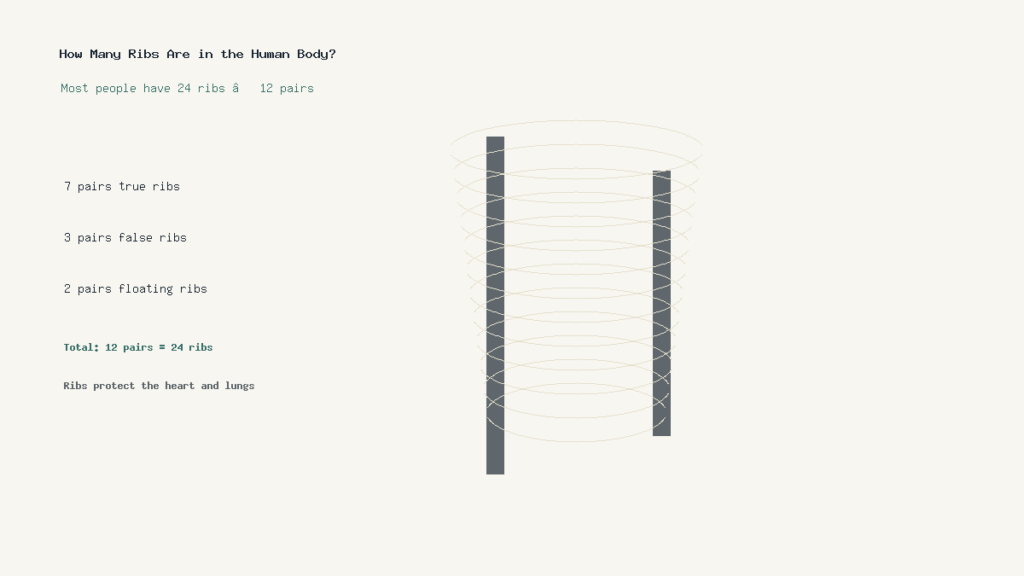
How many ribs are in the human body? Most people have 24 ribs, arranged as 12 pairs. These ribs form the rib cage, or thoracic cage, around the chest. They help protect the heart and lungs and also provide attachment points for muscles involved in breathing and upper-body movement.
When asking how many ribs are in the human body, the standard answer comes from this pattern: seven pairs of true ribs, three pairs of false ribs and two pairs of floating ribs. That adds up to 12 pairs in total.
Table of Contents
How Many Ribs Are in the Human Body?
In the typical adult skeleton, there are 12 pairs of ribs, or 24 ribs total. The National Library of Medicine’s NCBI Bookshelf describes the thoracic cage as the sternum plus 12 pairs of ribs and their costal cartilages. The ribs connect at the back to the thoracic vertebrae.
Each pair has one rib on the left side and one on the right. Together, the ribs curve around the chest to form a protective framework around major organs.
What Are True, False and Floating Ribs?
The 12 pairs are grouped according to how they connect at the front of the chest.
- True ribs: Pairs 1 through 7 attach to the sternum through their own costal cartilage.
- False ribs: Pairs 8 through 10 connect indirectly through cartilage that joins the cartilage above.
- Floating ribs: Pairs 11 and 12 do not attach to the sternum at the front.
All 12 pairs still connect to the spine at the back. The difference is mainly in their front attachment.
What Do the Ribs Do?
The rib cage has several jobs. Its best-known role is protecting organs in the chest, especially the heart and lungs. It also supports the shape of the chest and provides attachment sites for muscles.
Ribs also move slightly during breathing. Muscles between the ribs help change the size of the chest cavity as you inhale and exhale, working with the diaphragm to move air in and out of the lungs.
Can People Have a Different Number of Ribs?
Yes. Twenty-four ribs is the usual number, but anatomical variation exists. Cleveland Clinic notes that some people have a different number of ribs than others. Extra ribs can occur, including a cervical rib that develops above the usual first rib, while some people may have fewer ribs.
These variations are not the typical pattern, which is why anatomy references still describe 12 pairs as the standard human rib count.
Do Men and Women Have the Same Number of Ribs?
Yes. Men and women normally have the same number of ribs: 12 pairs, or 24 total. The idea that men have one fewer rib is not supported by human anatomy.
Like other skeletal traits, rib counts can vary from person to person, but those variations are not determined simply by sex.
How Are the Ribs Connected?
At the back, ribs connect with the thoracic vertebrae of the spine. At the front, most ribs connect directly or indirectly to the sternum through flexible costal cartilage. That cartilage gives the rib cage some movement instead of making the chest completely rigid.
The bottom two pairs are called floating ribs because they have no front attachment to the sternum.
Frequently Asked Questions
How many pairs of ribs are in the human body?
Most people have 12 pairs of ribs.
How many ribs are in the human body altogether?
The typical total is 24 ribs: 12 on the left and 12 on the right.
How many floating ribs do humans have?
Most people have two pairs of floating ribs, ribs 11 and 12.
Are ribs bones or cartilage?
The ribs themselves are bones. Costal cartilage connects many of them to the sternum at the front of the chest.
The Short Answer
Most humans have 24 ribs, arranged in 12 pairs. Seven pairs are true ribs, three pairs are false ribs and two pairs are floating ribs. Variations do occur, but 12 pairs is the standard anatomical pattern.
For another Human Body question, see what the largest organ in the human body is, or browse the Human Body section.