Table of contents
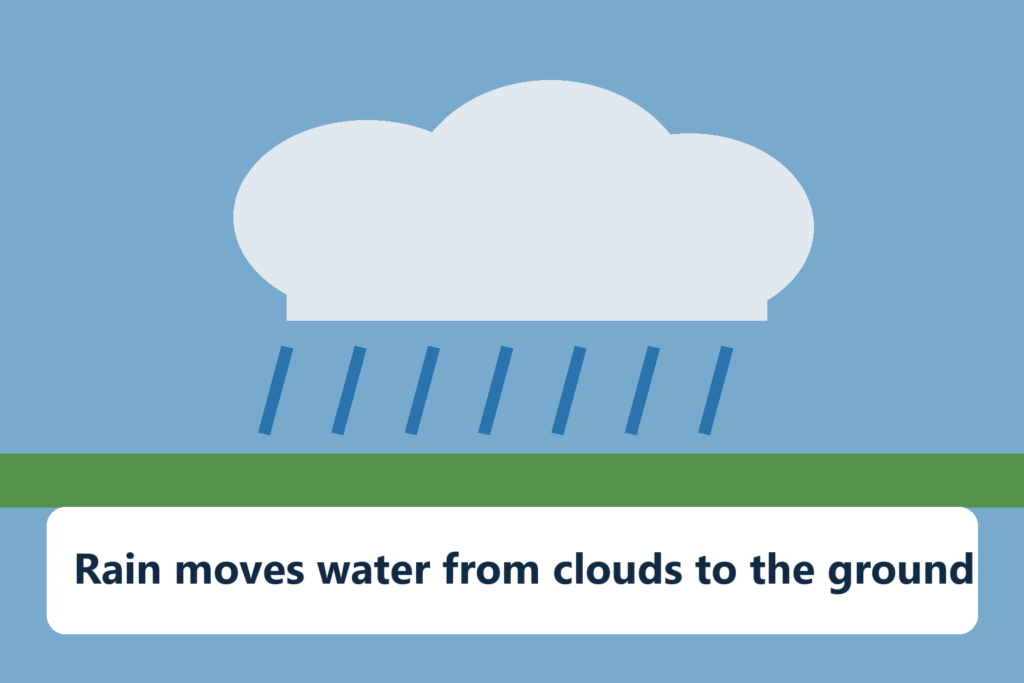
What is rain? Rain is liquid water that falls from clouds to Earth. Understanding what is rain helps explain the water cycle. It forms when water vapor cools, condenses into droplets, and those droplets grow heavy enough to fall through the air. Rain is one type of precipitation, alongside snow, sleet, and hail. Knowing what is rain makes weather forecasts easier to understand.
The short answer
Rain begins with the water cycle. Sunlight warms oceans, lakes, soil, and plants, causing some water to evaporate into invisible vapor. Rising air carries that vapor higher, where cooler temperatures help it condense around tiny particles such as dust or salt.
How rain forms
Inside a cloud, condensed water gathers into microscopic droplets or ice crystals. Air currents keep many of them suspended. Droplets collide and merge, becoming larger. When gravity overcomes the cloud’s upward-moving air, the drops begin to fall as rain.
Not every falling drop reaches the ground. In dry air below a cloud, some evaporate before they arrive. This can create virga, a streak of precipitation that disappears above the surface.
Why clouds release rain
Clouds contain countless droplets, but they do not automatically produce rain. The droplets must grow large enough to fall. Warm clouds mainly grow drops through collisions and merging. In colder clouds, ice crystals can grow while nearby water droplets shrink; the crystals may then melt into raindrops as they descend.
Updrafts, temperature, humidity, and cloud height all affect how much rain reaches the ground. A tall storm cloud can hold strong rising air and release heavy showers, while a thin layer cloud may produce only drizzle.
Different kinds of rain
Drizzle is made of very small drops and often falls from low, gray clouds. Showers begin and end more suddenly and can vary greatly from one neighborhood to the next. Steady rain usually comes from broad cloud systems that cover a larger area. Thunderstorms can produce intense rain, gusty winds, lightning, and sometimes hail.
When asking what is rain, it also helps to know that rainfall is measured with a rain gauge. Weather services compare measurements over hours, days, and seasons to describe droughts, floods, and normal patterns. Radar can also estimate where precipitation is moving and how intense it is.
Why rain matters
Rain replenishes streams, lakes, groundwater, and soil moisture. Plants use that water for photosynthesis and growth, while animals and people depend on freshwater supplies. Too little rain can dry landscapes and reduce crops. Too much rain in a short time can overwhelm drainage systems, erode soil, and cause flooding.
Rain is also part of a repeating system rather than a one-way loss. Water that falls may soak into the ground, run into rivers, or evaporate again. Learning what is rain helps explain weather forecasts and the water cycle.
Rainfall can vary sharply across a town because wind, terrain, storm motion, and drop size all affect where water lands. Meteorologists compare rain gauges with radar and satellite data to track those differences. Forecast percentages describe the chance of measurable rain at a location, while actual totals can still differ from one street to another. Once rain reaches the ground, some flows across hard surfaces and some soaks into soil, so a brief downpour can create local flooding even when the wider storm total is not especially large.
Rain can be gentle enough for gardens or powerful enough to reshape streams. Watching the changing sky is a simple way to connect everyday weather with the larger water cycle.
For a companion explanation, read Why does it rain? and How does rain help plants?.
Related questions
- Why does it rain?
- Where does rain come from?
- How does rain help plants?
- What is a cloud made of?