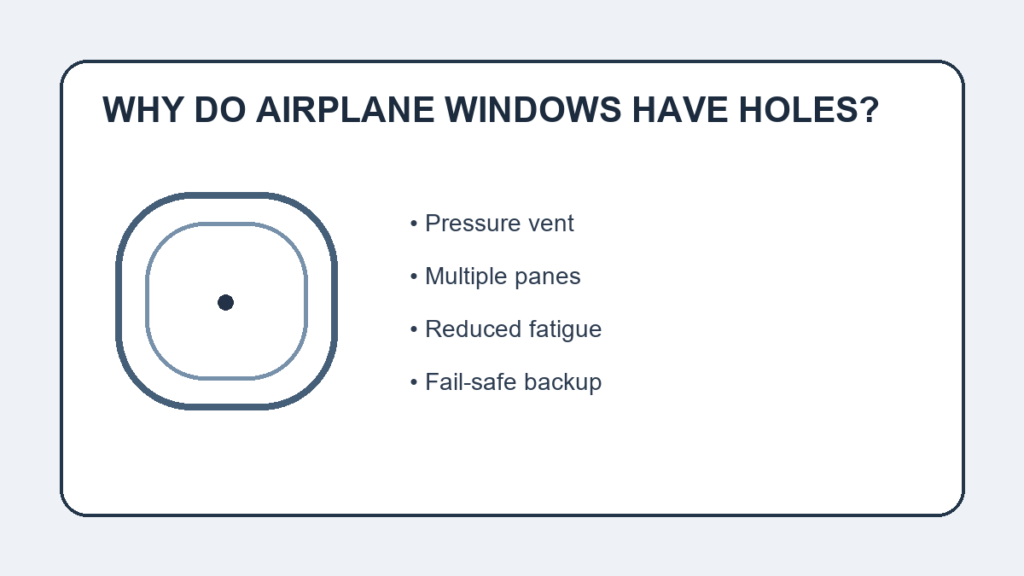
Why do airplane windows have holes? That tiny opening is there to manage pressure between the layers of the passenger window. It helps the window assembly share pressure loads correctly, reduces unnecessary stress on the inner pane, and supports the fail-safe design used in pressurized aircraft.
Table of Contents
Why Do Airplane Windows Have Holes? The Short Answer
The small hole in many airplane passenger windows is usually a vent or breather hole in the inner structural pane. It allows cabin pressure to reach the space between window panes. That means the outer pane normally carries the pressure load, while the inner pane is protected from repeated pressurization cycles and remains available as a backup.
1. Airplane Windows Have Multiple Layers
Passenger windows are not a single piece of plastic. The FAA describes pressurized-aircraft window assemblies as multi-pane structures with mounting hardware, seals, and fail-safe features.
Airbus explains that a typical cabin window has both outer and inner structural panes, plus an additional transparent lining on the cabin side that protects the window from passenger contact and scratches.
2. The Hole Equalizes Pressure Between Panes
Why do airplane windows have holes? The key reason is pressure management. During flight, cabin pressure is much higher than the air pressure outside the aircraft.
The small vent hole lets cabin air enter the space between the inner and outer panes. Airbus states that this arrangement allows the outer pane to carry the normal pressure load while preventing the inner pane from being repeatedly loaded during each pressurization cycle.
3. It Helps Reduce Fatigue on the Inner Pane
Why do airplane windows have holes? One important reason is to reduce repeated pressure loading on the inner structural pane.
Pressurization is not a one-time event. An airliner goes through thousands of cycles as it climbs, cruises, descends, and returns to ground pressure.
If both structural panes had to carry the full pressure difference on every flight, both would experience repeated loading. By venting the space between the panes, the inner pane avoids that normal cycle and therefore experiences less structural fatigue.
This is a good example of a small design detail reducing long-term stress on a much larger system.
4. The Window Is Designed to Be Fail-Safe
Why do airplane windows have holes? The vent also supports the way the window assembly separates normal pressure carrying from backup protection.
Modern transport-aircraft windows are designed so that the window assembly can tolerate a failure without immediately losing cabin pressure.
Airbus says both the inner and outer structural panes are capable of sustaining the maximum cabin differential pressure. In normal operation, the outer pane carries the load. If that pane fails, the inner pane is designed to take over and maintain cabin pressure long enough for the aircraft to continue safely.
The FAA also requires pressurized-aircraft window systems to account for structural integrity and fail-safe performance.
5. Why the Hole Is So Small
Why do airplane windows have holes? Because only a small controlled path is needed to equalize pressure between the panes.
The opening does not need to be large because it is not intended to move huge amounts of air quickly. Its job is to let the pressure in the space between the panes adjust gradually to cabin pressure.
A small opening does that without weakening the pane unnecessarily or creating a large path for airflow.
6. It Is Not Mainly a Drain Hole
The tiny opening is sometimes described online as a way to prevent condensation or let moisture escape. Pressure management is the main structural reason for the vent hole.
Managing the pressure between panes can also affect temperature and moisture conditions in that space, but the design purpose is fundamentally tied to how the window carries cabin-pressure loads.
7. The Hole and the Rounded Shape Solve Different Problems
Why do airplane windows have holes? The vent hole manages pressure between the panes. The rounded shape of the window solves a different structural problem: it reduces stress concentrations around the opening in the fuselage.
Those two features work together as part of a larger safety system. The curved opening helps the fuselage handle repeated pressurization, while the layered panes and vent hole control how pressure is carried through the window assembly.
For the related design question, see Why Are Airplane Windows Round?.
Frequently Asked Questions
What is the tiny hole in an airplane window called?
It is commonly called a vent hole, breather hole, or bleed hole. The exact terminology varies, but the function is to let cabin pressure reach the space between the structural panes.
Does air leak out of the airplane through that hole?
No. The hole is in one layer of the window assembly, not an open passage directly through the aircraft. The outer pane and the rest of the window assembly still separate the pressurized cabin from the outside air.
What happens if the outer airplane window pane cracks?
In a fail-safe design, the inner structural pane is intended to be capable of carrying the cabin-pressure load if the outer pane can no longer do so. The exact response depends on the aircraft and the type of damage.
Is the pane passengers can touch structural?
Often the layer passengers can touch is a protective inner lining rather than the main pressure-carrying pane. Aircraft designs vary, but the structural panes are typically behind that protective layer.
Do all airplane windows have the same kind of hole?
No. Window assemblies differ by aircraft type and manufacturer. The small vent-hole arrangement is common, but the exact pane layout, materials, seals, and pressure-management design can vary.
Why Do Airplane Windows Have Holes? Bottom Line
Why do airplane windows have holes? Because the tiny vent helps manage pressure between the layers of the window. It lets the outer pane carry the normal pressure load, helps protect the inner pane from repeated fatigue cycles, and supports the fail-safe structure of the window assembly.
It is a tiny feature with an important job: helping a pressurized aircraft window stay reliable over thousands of flights.
Sources
- Airbus Safety First — Typical Cabin Window Structure
- FAA — AC 25.775-1: Windows and Windshields
- FAA — Passenger Window Airworthiness Directive Background
- FAA — de Havilland Comet Lessons Learned
Related questions: See also why airplane windows are round and what airplane windows are made of.