Table of contents
Why do spiders make webs? Many spiders make webs to catch food, but a web can do much more. Silk can create a shelter, protect eggs, provide a safety line, or help a young spider travel. A web is a tool shaped by a spider’s habitat, body, and hunting strategy.
How do webs catch prey?
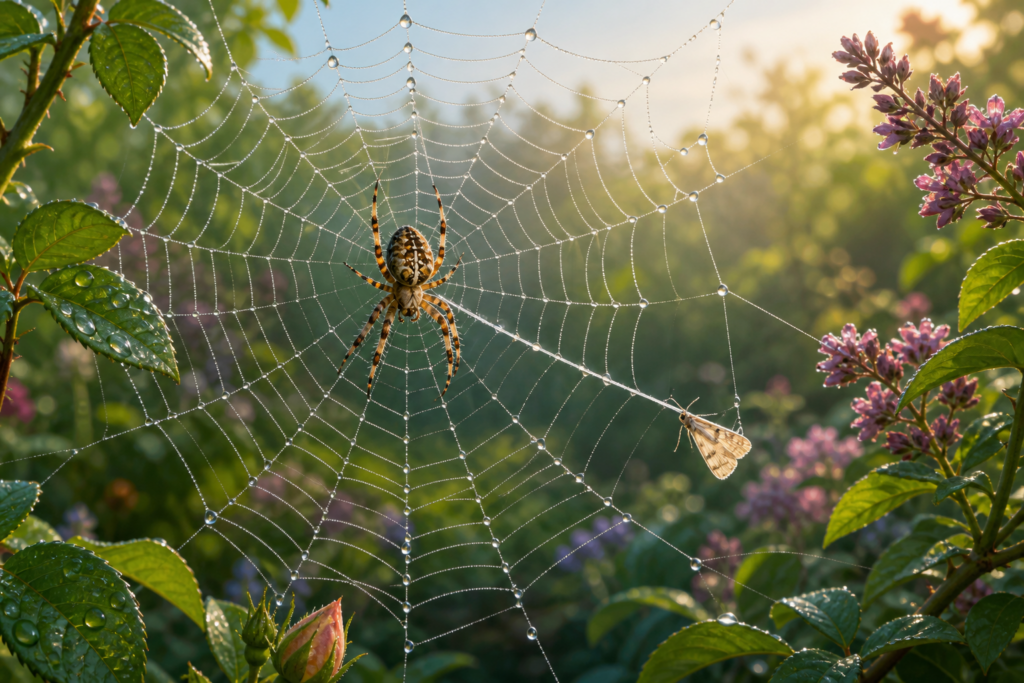
The familiar orb web works like a delicate trap. Strong frame threads hold the web in place, while spiral capture threads may have sticky droplets. When a fly, moth, or mosquito bumps into the web, the insect can become stuck. The spider feels vibrations traveling through the threads and can locate the struggling prey without seeing it clearly.
Some spiders add extra features, such as a zigzag band or a dense sheet. These designs may strengthen the structure, help camouflage the spider, or guide prey toward a hiding place. The web must be repaired regularly because wind, rain, and insects can damage it.
Why is spider silk useful?
Spider silk is light, flexible, and remarkably strong for its thickness. Spiders use different kinds of silk for different jobs. Dry dragline silk can form a frame or a safety line. Sticky silk can help capture prey. Soft silk can wrap eggs or make a retreat. To learn more about the material itself, read How do spiders make silk?.
Silk also helps spiders move. Tiny spiderlings can release strands that catch the breeze, a behavior called ballooning. A spider may leave a safety thread behind as it walks, allowing it to climb back up after a fall. Some species pull silk across leaves or between branches to make a protected home.
What kinds of spider webs are there?
- Orb webs: round webs with radial spokes and a spiral capture line.
- Sheet webs: flat silk sheets that catch insects dropping from above.
- Funnel webs: broad sheets that lead into a narrow retreat.
- Cobwebs: tangled three-dimensional webs common in corners and sheltered spaces.
- Triangle or irregular webs: specialized designs suited to a particular location and prey.
Web shape is not always a perfect identification guide. Weather, damage, age, and the spider’s species can change the appearance. A web in a garden may look different from one built under a rock even when both are made for hunting.
Do all spiders make webs?
No. Many spiders hunt by walking, running, jumping, or hiding and ambushing prey. Jumping spiders, wolf spiders, and crab spiders may use silk for a safety line, a shelter, or an egg sac without building a large capture web. This is why a spider without a visible web can still depend on silk.
Why do spiders make webs at night?
Some web-building spiders work at night because cooler, calmer conditions can reduce the chance of drying out or being noticed by predators. Other species rebuild at dawn or whenever an old web is damaged. The timing depends on the species, temperature, wind, light, and where prey is active.
Web building is also a balance between energy and reward. Making silk costs resources, so a spider usually chooses a place where insects are likely to pass. If a web catches little food, the spider may move, recycle some silk, or build a different design. Temperature, humidity, nearby plants, and the amount of wind all influence the best location.
When you see a web, look without touching it. Notice whether it is round, flat, tangled, or funnel-shaped, and look for a retreat where the spider can hide. A web can reveal how an animal solves problems with materials it produces itself.
Why do spiders make webs in a particular place? They choose a location where prey is likely to pass and where silk can anchor securely. Light, wind, humidity, and nearby plants all affect the design.
Related questions
- How do spiders make silk?
- Why do spiders take down their webs?
- Why do spiders make webs in corners?
- What is the strongest type of spider web?
- Do spiders sleep?
Sources
- Woodland Trust: Why spiders make webs
- Natural History Museum: Spider webs and silk
- Britannica: Spider silk
Why different spiders build different kinds of webs
Not every spider web has the familiar circular shape of an orb web. Different species build structures suited to the way they hunt and live. Orb-weaving spiders create organized webs that can intercept flying insects. Other spiders make sheet webs, funnel webs, tangled cobwebs, or small silk retreats. Some spiders do not use a capture web at all and instead chase or ambush prey.
The design of a web reflects tradeoffs. A large web can intercept more insects but requires silk, time, and a suitable location. A dense or three-dimensional web may work better in a protected corner. Spiders can also repair damaged sections or rebuild a web when it becomes ineffective. The silk itself can have different properties depending on its job, such as strength, stretchiness, or stickiness.
Our article on how spiders make silk explains where that material comes from. You can also read whether spiders sleep for another look at spider behavior.
A web is therefore more than a sticky trap. It is a tool shaped by the spider’s environment and hunting strategy, and the huge variety of webs reflects the huge variety of spiders that make them.