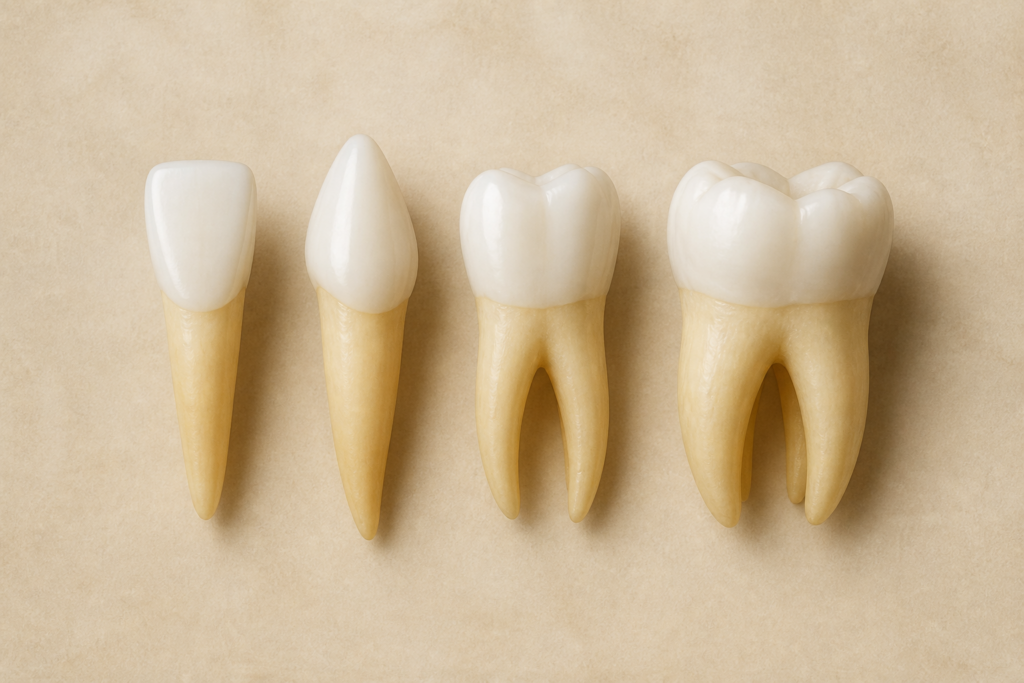
What are teeth for? Teeth help you bite and chew food, shape speech sounds, and support the structure of your mouth and face. Different teeth have different jobs: incisors cut, canines tear, and premolars and molars crush and grind.
Table of contents
What are teeth for?
Types of teeth and their functions make eating, speaking, and smiling possible. Teeth cut, tear, crush, and grind food into smaller pieces so it can mix with saliva and be swallowed more easily. Teeth also help form clear sounds and support the shape of the face.
Types of teeth and their functions
Most adults have four main types of teeth. Each type has a shape that suits its job, and they work together as one chewing team.
Incisors: cutting and biting
Incisors are the flat teeth at the front of the mouth. They help bite into foods such as apples, sandwiches, and carrots. Most adults have eight incisors: four on top and four on the bottom.
Canines: gripping and tearing
Canines are the pointed teeth beside the incisors. Their shape helps grip and tear food. Adults usually have four canines, two in each jaw.
Premolars: crushing and beginning to grind
Premolars sit behind the canines and have broader, ridged surfaces. They crush food and begin the grinding process. Adults normally have eight premolars.
Molars: powerful grinding
Molars are the large teeth at the back. Their wide surfaces are designed to grind food into a soft texture. Adults commonly have twelve molars when wisdom teeth are included, although wisdom teeth may be missing or removed.
How do teeth help with speech?
Teeth work with the tongue, lips, and cheeks to shape sounds. The front teeth help with sounds such as th, f, and v. A missing or changing tooth can temporarily affect pronunciation while the mouth adjusts.
How are baby teeth different?
Children grow a first set of 20 baby teeth. These teeth help with eating and speech, and they hold space in the jaws for permanent teeth. As adult teeth develop, baby teeth loosen and fall out in stages. Caring for baby teeth still matters because decay can cause pain and affect eating or sleep.
How should you care for your teeth?
Knowing what are teeth for also explains why different brushing and cleaning habits protect different surfaces.
- Brush twice a day for about two minutes with fluoride toothpaste.
- Clean between teeth with floss or another recommended tool.
- Limit frequent sugary drinks and snacks.
- Wear a mouthguard for activities where teeth could be injured.
- Ask a dentist about pain, swelling, bleeding, or a damaged tooth.
For another simple explanation, read Why should we brush our teeth? and explore the People category.
How do the different teeth work together?
Chewing is a team effort. Incisors take the first bite, canines help hold and tear, premolars crush, and molars finish the grinding. Saliva softens the food as you chew, while the tongue moves it around the mouth and helps prepare it for swallowing.
Teeth are covered by enamel, a hard outer layer. Under the enamel is dentin, which surrounds the pulp. The pulp contains nerves and blood vessels. This structure lets a tooth do its job while also explaining why damage can sometimes feel painful.
Tooth shapes are not identical in every person. Size, spacing, wisdom teeth, and the number of adult teeth can vary. That is one reason a dentist looks at the whole mouth rather than judging a single tooth in isolation.
Good oral care protects every type of tooth. A regular routine also makes it easier to notice changes early and discuss questions during a dental visit.
Learning the types of teeth and their functions makes everyday dental care easier to understand.
When people ask, what are teeth for, the short answer is that each tooth shape has a specific job.
Related questions
- How many teeth do adults have?
- Are teeth bones or organs?
- What are teeth made of?
- Why do children lose baby teeth?
- What do wisdom teeth do?