Table of contents
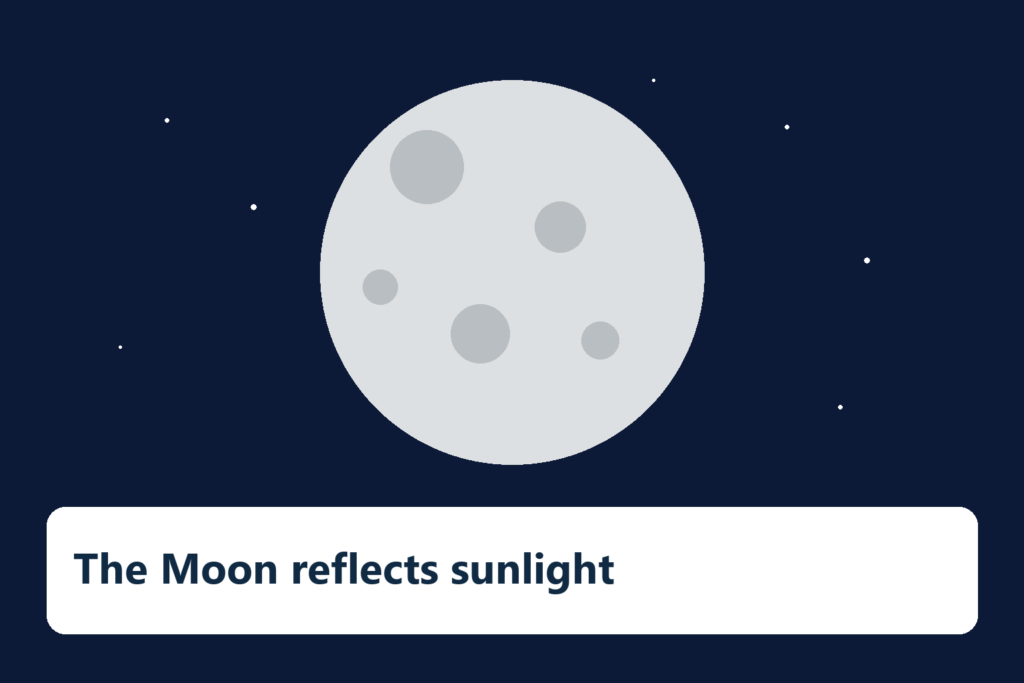
What is the Moon? The Moon is Earth’s natural satellite, a rocky world that orbits our planet. It does not make its own visible light; it reflects sunlight. The Moon is the fifth-largest natural satellite in the solar system and the only one humans have visited.
A natural satellite
Gravity keeps the Moon in orbit about 384,400 kilometers from Earth on average. The Moon rotates once in roughly the same time it completes one orbit, so nearly the same side always faces Earth. The far side is not permanently dark; it receives sunlight too.
Scientists think the Moon formed after a giant impact early in Earth’s history. Its orbit is slightly tilted, which is why eclipses do not happen every month. The Moon’s gravity pulls on Earth’s oceans and contributes to tides.
Surface and interior
The lunar surface has bright highlands, dark volcanic plains called maria, mountains, and countless craters. With almost no atmosphere, the Moon has extreme temperature changes and little protection from micrometeoroids. Footprints can remain for a very long time because wind and rain do not erase them.
Below the surface are a crust, mantle, and small core. Robotic missions and samples returned by astronauts have helped researchers learn about its minerals, history, and water ice in permanently shadowed polar craters.
Effects on Earth
The Moon’s gravity raises bulges in Earth’s oceans. As Earth rotates through these bulges, coastlines experience high and low tides. Tides also affect estuaries, shore habitats, and the timing of some animal behaviors.
The Moon helps stabilize the tilt of Earth’s axis over long periods. Its phases are changing views of the sunlit half as the Moon travels around Earth. A full Moon is not brighter because it makes light; it is brighter because we see more illuminated surface.
Common questions
Can people live on the Moon? Long-term living would require sealed habitats, life support, radiation shielding, and reliable supplies. Is there water? Yes, spacecraft have detected ice in some cold polar shadows. Why does it look large near the horizon? That is mainly a visual illusion; measurements show its apparent size changes very little.
For related reading, see Why does the Moon shine? and Why does the Moon look like it changes shape?.
When readers ask what is the Moon, they may also wonder how it affects calendars, tides, and exploration. These effects follow from a rocky satellite reflecting sunlight while orbiting Earth.
Understanding what is the Moon means separating its own properties from the changing view we see in the sky. Its round body stays the same while sunlight and viewpoint change.
How we learned what the Moon is made of
Scientists study the Moon with telescopes, orbiting spacecraft, robotic landers, and samples brought back by Apollo astronauts. Those samples show that the Moon is made of familiar rocky minerals, but its surface has been shaped by billions of years of impacts and volcanic activity rather than by wind or flowing water.
Modern missions also map gravity, temperature, surface chemistry, and permanently shadowed polar regions. Together, those measurements help researchers reconstruct the Moon’s history and identify places where water ice can survive despite the Moon’s overall dryness.
Why the Moon has so many craters
The Moon preserves a record of impacts that Earth often erases. Asteroids and smaller objects have struck both worlds throughout solar-system history, but Earth has weather, oceans, moving crust, and active geology that continually reshape its surface. The Moon has almost no atmosphere and no rain, so many impact scars remain visible for extremely long periods.