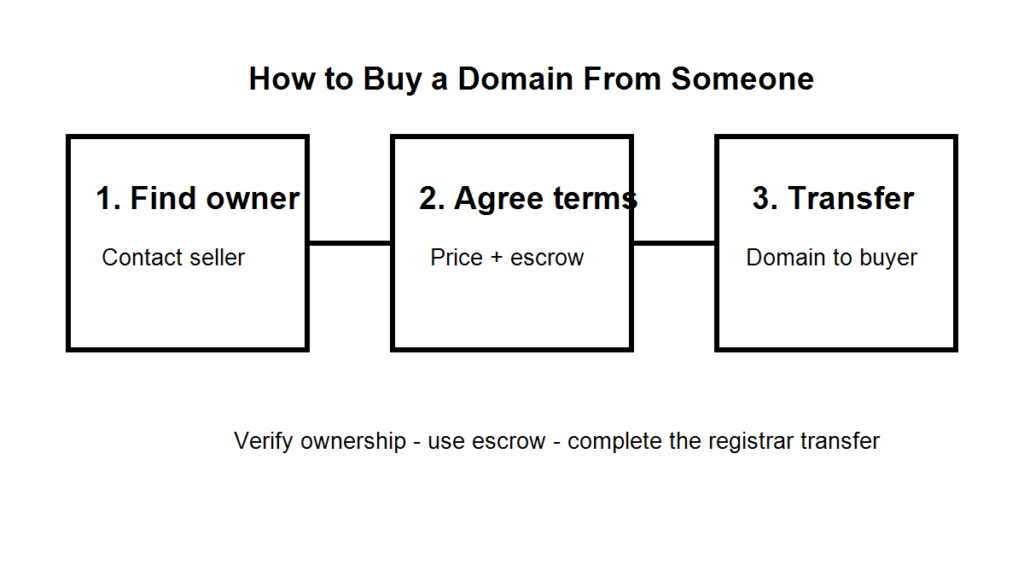
How to buy a domain from someone safely: confirm who controls the domain, agree on a price and terms, use a trusted escrow service for payment, and complete the ownership transfer through the registrar. Do not send money until you understand exactly how the domain will move into an account you control.
Table of Contents
Explore more practical questions in our Technology & Machines section.
1. Make Sure the Domain Is Actually Owned by Someone Else
Start by checking whether the domain is already registered. If it is available through a registrar, you can simply register it. If it is already taken, the process becomes a private purchase from the current registrant rather than a normal new registration.
ICANN explains that if you want a domain somebody else has already registered, one option is to work out an agreement with the current registrant. The registrar that manages the domain will ultimately be involved in changing the registrant or moving the domain between accounts or registrars.
2. Find a Reliable Way to Contact the Owner
Many domain registration records no longer display a registrant’s personal contact information publicly, so finding the owner may take more than one method. Check the website on the domain for a contact page, look for a sales landing page, or use the registrar’s contact or privacy-forwarding system if one is available.
If the domain is listed on a marketplace, use the marketplace’s contact system instead of moving the conversation elsewhere too quickly. Keeping the negotiation inside an established platform can create a clearer record of the offer and the agreed terms.
3. Decide What the Domain Is Worth to You
When learning how to buy a domain from someone, price is one of the hardest parts because there is no single correct value for a privately owned domain. The seller may have a number in mind that is much higher than the original registration fee. Before you make an offer, decide what the domain is worth for your specific project and set a maximum you are willing to pay.
- How closely the name matches your brand or business
- Whether good alternatives are still available
- The length and memorability of the domain
- The extension, such as .com, .org, or a country-code ending
- Whether the domain already receives useful traffic or has a legitimate history
Automated appraisal tools can provide a reference point, but they do not know what a specific domain is worth to a particular buyer or seller. Treat an automated estimate as one input, not as a guaranteed market value.
4. Agree on the Price and the Transfer Terms
Before money changes hands, both sides should agree on the domain being sold, the purchase price, who will pay any escrow or transfer fees, the expected transfer method, and what counts as a completed transaction.
The transfer can be simpler when both parties use the same registrar because some registrars allow an internal account change or account-to-account push. If the buyer and seller use different registrars, the process may require an inter-registrar transfer and an authorization code. Exact steps vary by registrar.
5. Use Escrow Instead of Paying the Seller Directly
A key part of how to buy a domain from someone safely is avoiding direct payment before the transfer is secured. For a meaningful purchase amount, escrow reduces the risk that one side must trust the other blindly. Escrow.com describes a standard domain transaction in which the buyer and seller agree to the terms, the buyer funds the escrow account, and the seller is told to transfer the domain only after the payment has been secured.
After the domain reaches the buyer, the buyer confirms receipt or the escrow provider verifies that the transfer is complete. The escrow provider then releases payment to the seller. This structure helps prevent the two most obvious problems: a buyer sending money but never receiving the domain, or a seller transferring the domain and never receiving payment.
6. Complete the Domain Transfer
How the domain is transferred depends on the registrar setup. A same-registrar transfer may use an internal ownership change. A transfer to a different registrar may require the seller to unlock the domain and provide an authorization code that the buyer enters at the gaining registrar.
ICANN’s transfer rules allow registered name holders to transfer eligible domains between registrars, but certain conditions can temporarily prevent a transfer. For example, a domain may be subject to a 60-day restriction after a new registration, a previous registrar transfer, or some changes to registrant information.
This is why the order of operations matters. ICANN specifically advises checking the registrar’s policy before changing registrant information if the final goal is also to move the domain to a different registrar. Depending on the registrar and situation, changing ownership first can trigger a lock that delays the registrar transfer.
7. Verify That You Control the Domain Before the Deal Is Finished
Do not treat the transaction as complete just because the seller says the transfer was started. Log in to your own registrar account and confirm that the domain appears there under your control. Check that you can manage the domain’s contact information, nameservers, security settings, and renewal options.
Once control is confirmed, make sure automatic renewal is configured the way you want it and add account protections such as two-factor authentication. The domain itself may be valuable, so protecting the registrar account is part of protecting the purchase.
What Can Go Wrong When Buying a Domain From Someone?
- Paying too early: sending money directly before the transfer is secured can leave you with little protection.
- Buying from the wrong person: make sure the seller actually controls the domain.
- Unexpected transfer locks: registrar and ICANN rules can delay an inter-registrar transfer.
- Unclear terms: decide in advance who pays fees and exactly when the transaction is considered complete.
- Account-security problems: securing the domain but leaving the registrar account poorly protected creates a new risk.
How to Buy a Domain From Someone Safely
It can be. The transaction is much safer when you verify the seller, document the terms, use a reputable escrow service, and follow the registrar’s official transfer process. The risky version is sending money directly to a stranger and hoping the domain arrives afterward.
For an expensive domain, consider getting professional help if there are legal, trademark, tax, or contract questions. A normal domain transfer guide cannot determine whether a specific name creates a legal problem for your planned use.
Frequently Asked Questions
Can I buy a domain that is already registered?
Yes. If the current registrant is willing to sell it, you can negotiate a private purchase and have the domain transferred to you. ICANN identifies reaching an agreement with the current registrant as one option for acquiring a domain that is already registered.
Do I need an escrow service to buy a domain?
It is not always mandatory, but it can substantially reduce transaction risk because the payment is held while the domain transfer is completed. That is especially useful when the buyer and seller do not already know and trust each other.
How long does a domain transfer take?
The timing depends on whether the transfer is within the same registrar or between different registrars, whether both parties respond promptly, and whether a transfer lock applies. Check the exact procedure with the registrar involved rather than assuming every domain transfer follows the same timeline.
What is a domain authorization code?
An authorization code, often called an Auth-Code or EPP code, is used in many transfers between registrars. The current registrar provides the code to the authorized registrant, and the buyer or gaining registrar uses it as part of the transfer process.
The Short Answer
To buy a domain from someone, confirm that the seller controls the domain, negotiate the price and terms, place the payment with a trusted escrow service, complete the registrar transfer, and verify that the domain is fully under your control before the seller is paid. Check the registrar’s transfer rules before changing ownership details because a 60-day transfer lock can apply in some situations.
Sources
- ICANN — About Change of Registrant
- ICANN — FAQs for Registrants: Transferring Your Domain Name
- ICANN — Transfer Policy
- Escrow.com — How Domain Transactions Work
- Escrow.com — How to Transfer Domain Names
Related questions: For more technology basics, browse our Technology & Machines questions or start with what electricity is.