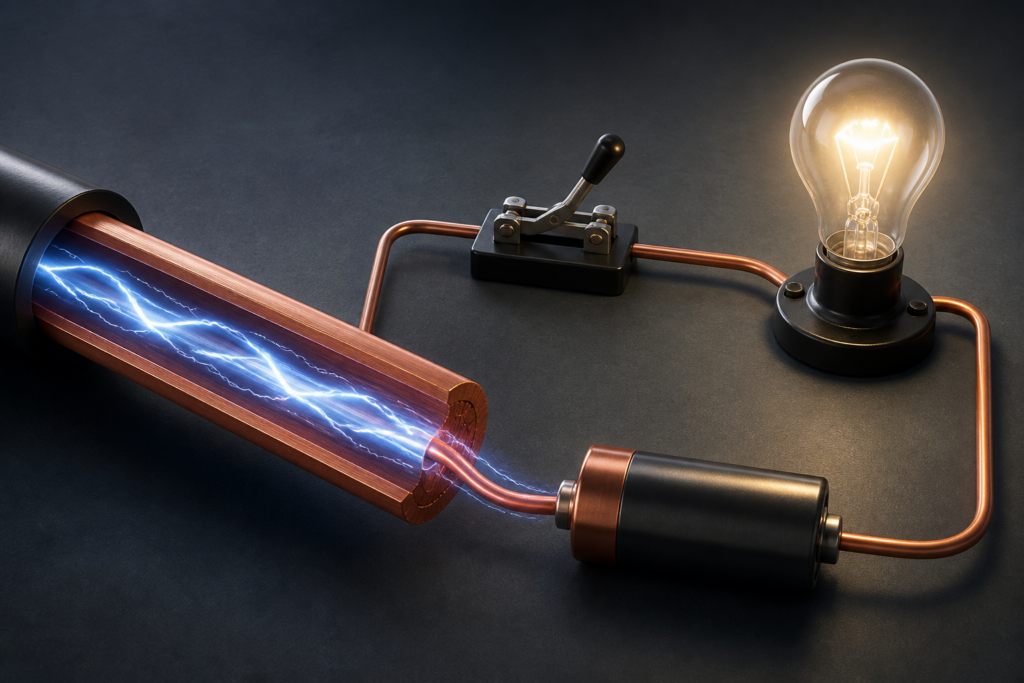
What is electricity? Electricity is the movement or buildup of electric charge. It can transfer energy through wires and power lights, motors, heaters, computers, and many other devices.

Table of contents
What is electric charge?
Atoms contain positively charged protons, uncharged neutrons, and negatively charged electrons. When electrons move from one place to another, an electric current can form. A buildup of charge that stays in one place is called static electricity, such as the charge behind a small spark after walking across a carpet.
How does current flow?
Current flows when a complete circuit gives charges a continuous path. A battery, generator, or power station provides the push called voltage. Wires carry current, switches open or close the path, and resistance describes how strongly a material opposes the flow. The circuit must be complete for useful current to continue.
What can electricity do?
Electricity transfers energy into other forms. In a light bulb it becomes light and heat. In a motor it becomes movement. In a speaker it becomes sound, and in a charger it stores energy in a battery. The device determines how the electrical energy becomes useful work.
Where does electricity come from?
Power plants and renewable systems such as wind turbines, hydropower, and solar panels generate electricity. Transformers raise or lower voltage, and power lines carry it through the grid. Homes receive electricity through a service connection, where a breaker panel divides it into protected circuits. Learn how electricity gets to your home.
Is electricity dangerous?
Yes. Current can cause shocks, burns, fires, or equipment damage. Keep water away from electrical equipment, use undamaged cords, and leave repairs to qualified professionals. A breaker or safety device can interrupt a circuit, but it is not a substitute for safe behavior.
Short answer
What is electricity? It is energy associated with electric charge, often carried by moving electrons in a circuit. That energy can be generated, transmitted, controlled, and changed into light, heat, motion, or sound.
How electricity behaves in a circuit
Electricity needs a path and a source of electrical pressure. In a simple battery circuit, chemical energy pushes charges around a loop. In a home, a generator and the grid provide the voltage, while wires provide a route. A switch changes whether the loop is complete. If a wire is broken, current stops even though charge may still be present on either side.
Conductors and insulators
Materials differ in how easily they allow charge to move. Metals such as copper and aluminum are good conductors, which is why they are used inside electrical cables. Rubber, glass, and dry wood resist current and are often used as insulation. Moisture can make some surfaces conduct more easily, so electricity and water should be kept apart.
Why electricity matters every day
Electricity supports communication, refrigeration, heating, transportation, lighting, and medical equipment. The same principles apply whether the source is a small battery or a large power station. Learning what is electricity helps you understand why circuits need protection and why every appliance has a specific voltage and current rating.
How is electricity measured?
Electricity is described with a few useful measurements. Voltage is the electrical push, current is the rate at which charge flows, and resistance opposes that flow. Power describes how quickly electrical energy is used. A small phone charger and a large oven both use electricity, but their voltage, current, and power ratings are different. These ratings help engineers choose safe wires, plugs, breakers, and appliances.
How can you use electricity safely?
Keep cords in good condition, avoid overloading outlets, and follow the instructions supplied with each appliance. Turn off power before any approved maintenance, and ask a qualified electrician to handle household wiring. These simple habits reduce the chance of shock, overheating, or fire.
When you ask what is electricity, the practical answer is energy carried by charge through a circuit. Knowing what is electricity also explains why batteries, outlets, and generators can all power devices in different ways.
Sources
- U.S. Energy Information Administration: Electricity Explained
- U.S. Department of Energy: Electricity
- OpenStax Physics: Electric Charge and Electric Field
Electricity is about moving and separated charge
When people say “electricity,” they can mean several related things. Static electricity involves an imbalance of electric charge that can build up on surfaces. Electric current is the movement of charge through a material. Voltage describes a difference in electric potential that can push charge through a circuit. These ideas are connected, but they are not identical.
In household wiring, generators and other sources create conditions that allow electric current to move through conductors. Devices such as lamps, motors, and electronics use that electrical energy and convert it into light, motion, heat, sound, or other forms. Circuits also include protective devices because too much current can overheat wires or damage equipment.
For a familiar everyday example, read what static electricity is. To follow electrical energy through the larger grid, see how electricity gets to your home.
Electricity can feel mysterious because electric charge is not something we see directly. We see its effects: a bulb lights, a motor turns, a spark jumps, or a phone charges. Thinking in terms of charge, voltage, current, and circuits makes those effects easier to connect.