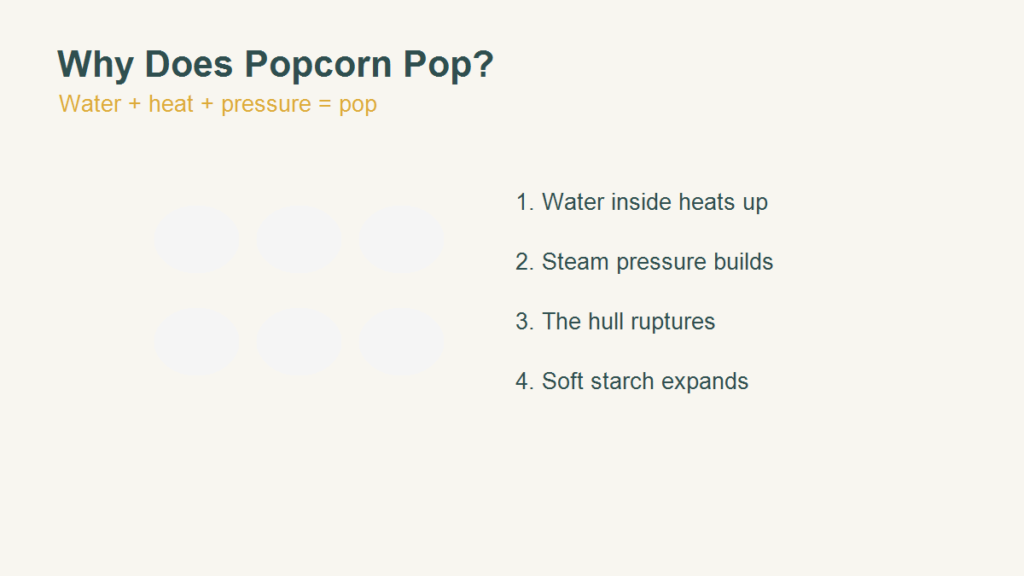
Why does popcorn pop? A popcorn kernel pops because heating turns the small amount of water trapped inside it into steam. Pressure builds inside the kernel’s strong outer shell until the shell ruptures. The hot, softened starch inside rapidly expands, cools and sets into the white, fluffy shape we recognize as popcorn.
Popcorn is a special type of corn because its kernels combine a tough, relatively moisture-tight hull with the right kind of starchy interior and enough trapped water to create the pressure needed for a pop.
Table of Contents
Why Does Popcorn Pop?
The key to why popcorn pops is the combination of water, starch and a strong outer hull. According to the USDA National Agricultural Library, each kernel contains a small amount of water stored within a circle of soft starch, surrounded by a hard outer surface.
When the kernel is heated, that water becomes steam. The steam cannot easily escape through the hull, so pressure rises. At the same time, heat softens the starch inside the kernel.
What Happens Inside a Popcorn Kernel?
The American Chemical Society describes the process as a pressure-driven transformation. As the kernel gets hotter, liquid water vaporizes and the pressure inside increases. Eventually the hull can no longer contain that pressure and breaks open.
- Heat enters the kernel. Water and starch inside become hotter.
- Water becomes steam. The strong hull traps much of that vapor.
- Pressure rises. The heated starch becomes soft and gelatinized.
- The hull ruptures. Pressure drops almost instantly.
- The starch expands. The hot interior rapidly puffs outward and then cools into popcorn’s familiar white foam.
Research published by the Royal Society found that popcorn’s characteristic jump and pop occur at roughly 180°C under experimental conditions, although real cooking conditions vary.
Why Does Only Popcorn Pop This Way?
Not every corn kernel has the structure needed to make popcorn. The variety commonly used for popping, Zea mays everta, has a particularly hard outer hull that can hold pressure long enough for the inside to become hot and soft.
Other types of corn may contain water and starch, but their kernels generally do not have the same combination of hull strength and internal structure. They can split, roast or dry without producing the same dramatic puff.
Why Do Some Kernels Not Pop?
The kernels left at the bottom of the bowl are often called “old maids.” A kernel needs enough internal moisture and an intact hull to build pressure. If the hull is cracked, steam can leak out before enough pressure develops. If a kernel is too dry, it may also fail to create enough steam for a full pop.
That is why proper moisture content and storage matter. Popcorn that loses too much moisture over time can become harder to pop successfully.
Does Popcorn Turn Inside Out?
It can look that way, but the more precise description is rapid expansion. Once the hull breaks, the pressure suddenly falls and water vapor expands. The softened starch is pushed outward into a foam many times larger than the original kernel.
As that foam cools, it solidifies. The white part you eat is therefore the expanded starchy interior of the kernel.
Why Does Popcorn Make a Popping Sound?
The sound is associated with the sudden release of pressurized water vapor when the hull ruptures. Researchers studying popcorn acoustics found that the familiar “pop” is produced during this rapid pressure release rather than simply by the kernel hitting the pan.
Frequently Asked Questions
What temperature does popcorn pop?
Experimental research has observed popcorn beginning to pop at about 180°C (356°F). The exact temperature of an individual kernel can vary with moisture and cooking conditions.
Is there water inside popcorn kernels?
Yes. A small amount of water is naturally present inside the kernel. Heating that water into steam is essential to the popping process.
Can regular corn pop like popcorn?
Most other corn varieties do not pop like popcorn because their kernels lack the same hull and starch characteristics needed to trap steam and build sufficient pressure.
The Short Answer
Why does popcorn pop? Heat turns water inside the kernel into steam. Its tough hull traps the steam until pressure becomes high enough to rupture the shell. The hot starch then expands rapidly and cools into the fluffy popcorn you eat.
For more kitchen science, read why bananas turn brown and why onions make you cry, or browse Food & Cooking.