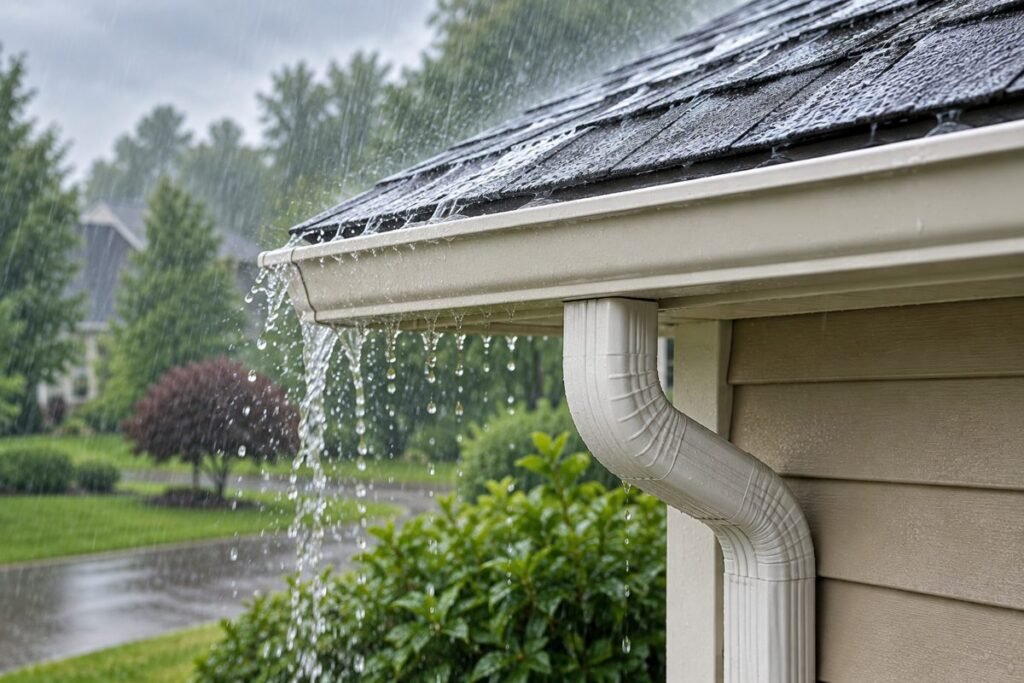
Why do houses have gutters? Gutters collect rainwater from the roof and direct it away from the house. That simple job helps keep large amounts of water from repeatedly soaking the soil next to the foundation, splashing against siding, eroding landscaping, and pouring over entrances and walkways.
Table of Contents
A roof can shed hundreds of gallons of water during a substantial rainstorm. Gutters and downspouts give that water a controlled route instead of letting it fall wherever it leaves the roof.
What Do Gutters Actually Do?
Rain lands on a sloped roof and runs toward its lower edges. A gutter catches much of that runoff. The water then flows through the gutter to a downspout, which carries it toward the ground.
The final part is important: water should be discharged far enough from the house that it does not simply collect beside the foundation. Depending on the property, downspouts may empty onto extensions, splash blocks, drainage systems, or other suitable areas.
Why Do Houses Have Gutters?
The main reason houses have gutters is water management. Concentrated roof runoff can create problems when it repeatedly lands in the same places.
Gutters can help reduce soil erosion below the roof edge, limit muddy splashback on walls, protect landscaping, and reduce the amount of roof water accumulating near a foundation. They can also keep sheets of water from falling directly over doors, patios, and paths.
Do Gutters Protect the Foundation?
They can be an important part of foundation water management. Gutters do not waterproof a foundation by themselves, but properly functioning gutters and downspouts can move roof runoff away from the base of a house.
Keeping water away from the foundation is also affected by grading, soil, drainage, and the condition of the foundation itself. A gutter system works best as one part of the property’s overall drainage strategy.
Why Don’t All Houses Have Gutters?
Not every house needs the same drainage setup. Local rainfall, roof design, soil conditions, foundation type, landscaping, and building practices all matter. Some homes use other methods to manage roof runoff, while houses in dry climates may have less need for extensive gutter systems.
Even when a house has gutters, they may not run along every roof edge. They are generally placed where runoff needs to be collected and redirected.
What Happens When Gutters Get Clogged?
Leaves, twigs, seeds, and other debris can block the flow of water. A clogged gutter may overflow, defeating much of the reason it is there. Standing water can also add weight to the system.
Downspouts can clog too. If water cannot leave the gutter, it may spill over the sides during heavy rain. Regular inspection and cleaning help keep the drainage path open.
Why Do Gutters Have Downspouts?
A gutter can collect water, but it still needs a way to get that water safely to ground level. Downspouts provide that route. They concentrate the gutter’s flow and carry it down the side of the house.
The bottom of a downspout should direct water away from the foundation rather than dumping it immediately beside the wall. Extensions or underground drainage may be used where appropriate.
Are Gutters Only for Rain?
Rain is their primary job, but gutters also receive water from melting snow and ice when temperatures rise. Cold climates introduce additional concerns because ice can block gutters and roof edges.
Gutters are therefore one small part of how buildings deal with weather. Another protective feature is the lightning-protection system explained in why buildings have lightning rods.
Why Do Houses Have Gutters If a Roof Already Sheds Water?
A roof sheds water, but it does not control where that water lands. Gutters catch the runoff at the roof edge and route it through downspouts to a more suitable drainage point.
Frequently Asked Questions
Are gutters necessary on every house?
No. Whether a particular house needs them depends on climate, roof design, drainage, soil, foundation conditions, and local construction practices. Many houses benefit from them, but there is no single answer for every structure.
Where should gutter water go?
It should be directed to a suitable drainage location away from the foundation. The exact solution depends on the property and local drainage requirements.
Why do some houses only have gutters in certain places?
Roof shapes direct water differently. Gutters may only be needed along roof edges where significant runoff would otherwise create drainage problems.
Can gutters cause problems?
Poorly installed, damaged, or clogged gutters can overflow or send water to the wrong place. The system needs a clear path and suitable discharge point to work properly.
The Short Answer
Why do houses have gutters? They collect water running off the roof and guide it through downspouts to a safer drainage location. This helps control roof runoff and can reduce erosion, splashback, and excess water near the foundation.
SmallQuestions covers other everyday building features too, including why ceiling-fan blades are angled and how lightning rods protect buildings.