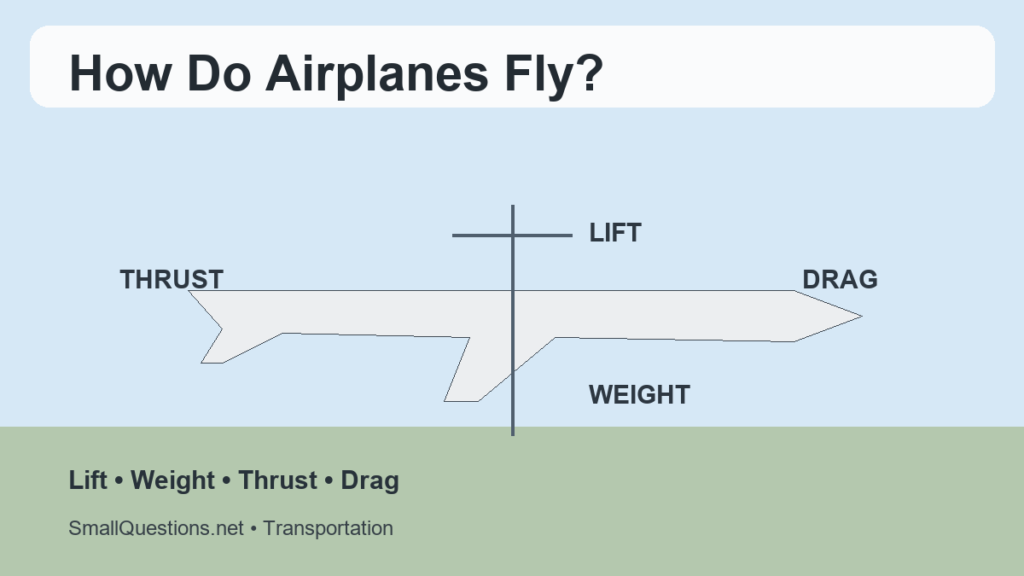
How do airplanes fly? Airplanes fly because their wings, engines, and control surfaces work together against four main forces: lift, weight, thrust, and drag. The engines push the airplane forward, air moving around the wings creates lift, gravity pulls the airplane downward, and air resistance pushes backward.
Table of Contents
What Are the Four Forces of Flight?
NASA describes four forces acting on an airplane in flight: lift, weight, thrust, and drag.
Lift acts mostly upward. Weight is the downward force of gravity. Thrust pushes the airplane forward, while drag resists that motion.
When these forces are balanced in the right way, an airplane can climb, cruise, descend, speed up, slow down, or turn.
How Do Airplane Wings Create Lift?
Airplane wings are shaped and angled so that moving air produces a net upward aerodynamic force. Part of that force is called lift.
It is common to hear that lift happens only because air travels faster over the curved top of a wing. That explanation is incomplete. Lift is better understood by looking at the pressure distribution around the wing and the way the wing changes the direction and momentum of the surrounding air.
The wing’s shape, angle of attack, airspeed, air density, and size all affect how much lift it can produce.
What Does the Engine Do?
The engine provides thrust. On a jet airplane, the engines accelerate air backward, producing a forward force on the airplane. Propeller-driven airplanes also create thrust by accelerating air backward with their propellers.
Thrust helps the airplane gain speed and overcome drag. Without enough forward speed, the wings cannot generate enough lift for normal flight.
How Does an Airplane Take Off?
One of the easiest ways to understand how do airplanes fly is to watch what happens during takeoff, when speed and lift build together.
During takeoff, the engines increase thrust and the airplane accelerates down the runway. As the wings move faster through the air, they produce more lift.
When the airplane reaches the required speed, the pilot raises the nose to increase the wing’s angle of attack. Lift becomes great enough to overcome the airplane’s weight, and the airplane leaves the ground.
How Does an Airplane Turn?
Airplanes turn mainly by banking. The pilot uses the ailerons to roll the airplane so that the lift force tilts to one side.
Part of the lift then points sideways, causing the airplane to curve through the air. The rudder and elevator help coordinate and control the maneuver.
How Does an Airplane Stay in the Air?
In steady, level flight, lift is approximately equal to weight and thrust is approximately equal to drag. That does not mean the forces never change. Pilots continuously adjust power and control surfaces as speed, altitude, wind, and other conditions change.
This balance explains how do airplanes fly for long distances without constantly climbing or falling. The airplane keeps moving forward fast enough for the wings to keep producing the lift needed to support its weight.
How Does an Airplane Land?
To land, the pilot reduces power and manages the airplane’s speed and descent. Flaps may be extended to change the wing’s lift and drag characteristics, allowing the airplane to fly more slowly while staying controllable.
Near the runway, the pilot raises the nose slightly in a maneuver called the flare. The airplane slows, lift decreases, and the landing gear touches the runway.
Do Airplanes Need Air to Fly?
Yes. Normal airplanes depend on air flowing around their wings to produce aerodynamic lift and on air for their engines or propellers to work. That is why a conventional airplane cannot fly in the vacuum of space.
Airflow also matters in many machines on the ground. For a simpler example of how moving air and rotating blades interact, see How Do Ceiling Fans Work?.
Frequently Asked Questions
How do airplanes fly if they are so heavy?
An airplane can be very heavy and still fly because its wings can generate enough lift to balance that weight when the aircraft moves through the air at the required speed.
Can an airplane fly without an engine?
Yes. Gliders can fly without engines because their wings still produce lift as they move through the air. They gradually lose altitude unless rising air helps them climb.
Why do airplanes need to go so fast?
More airspeed generally increases the amount of lift a wing can produce. Airplanes therefore need enough speed for the wings to support the aircraft’s weight.
What keeps a plane from falling?
Lift from the wings opposes the airplane’s weight. As long as the airplane maintains the necessary airflow and angle of attack, the wings can keep producing enough lift for controlled flight.
Do airplanes fly because of Bernoulli’s principle?
Bernoulli’s principle helps describe pressure changes in moving fluids, but it is not a complete explanation by itself. A full explanation of lift also considers the wing’s angle, pressure distribution, and the downward deflection of air.
The Short Answer
How do airplanes fly? Engines provide thrust to move the airplane forward, wings turn that motion through the air into lift, gravity pulls downward, and drag resists motion. Pilots use control surfaces to manage those forces and make the airplane climb, cruise, turn, and land.
Sources
- NASA Glenn Research Center — Four Forces on the Airplane
- NASA Glenn Research Center — What Is Lift?
- Federal Aviation Administration — Pilot’s Handbook of Aeronautical Knowledge
Related questions: Airplane design also explains why airplane windows are round and why airplane windows are so small.