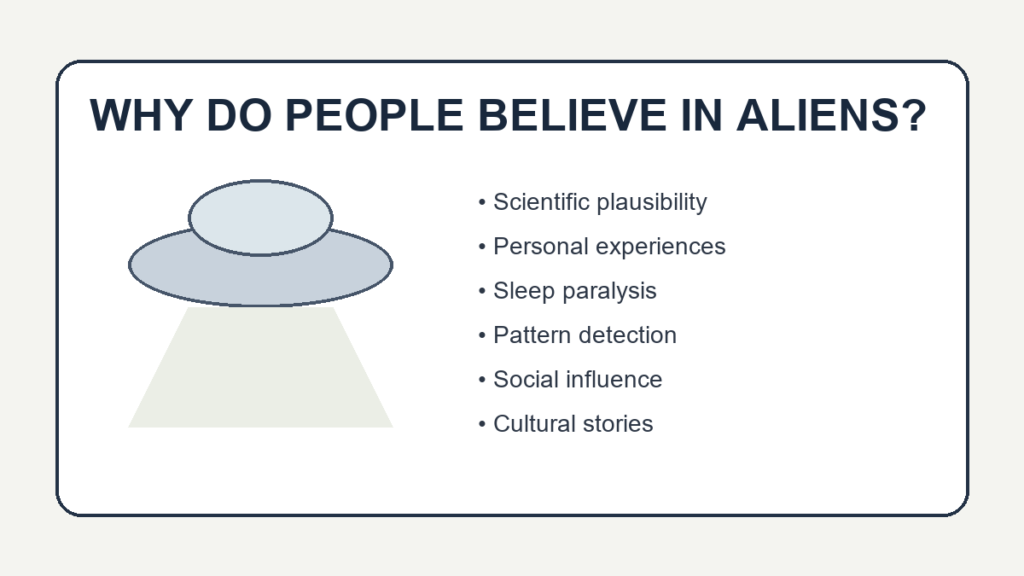
Why do people believe in aliens? The answer depends on what “believe in aliens” means. Some people simply think life probably exists somewhere else in the universe. Others believe extraterrestrials have visited Earth, are connected to UFO sightings, or have directly contacted humans. Those are very different claims. Research suggests alien belief can be shaped by scientific plausibility, personal experiences, sleep phenomena, social influence, pattern detection, distrust, and the human tendency to explain unusual events with familiar stories.
Table of Contents
Why Do People Believe in Aliens? The Short Answer
People believe in aliens for several different reasons. The universe is enormous, so the idea that life exists somewhere beyond Earth can seem scientifically reasonable. But beliefs about alien visitation, abductions, or UFO cover-ups involve additional assumptions that require additional evidence.
Psychology helps explain why people may interpret unusual experiences as alien encounters. Social and cultural influences can also make those interpretations more available and memorable.
1. Extraterrestrial Life Seems Scientifically Plausible
Why do people believe in aliens? Scientific plausibility is one reason. One reason alien belief differs from many paranormal beliefs is that extraterrestrial life is not scientifically impossible. Astronomers have discovered thousands of exoplanets, and scientists actively study the conditions that might support life elsewhere.
Research on extraterrestrial belief has found an important distinction between believing that life probably exists somewhere in the universe and believing that aliens have visited Earth. A study comparing Austrian and British respondents found that general belief in extraterrestrial life was different from stronger beliefs about alien visitation and government knowledge.
That distinction matters. Someone can reasonably think microbial or intelligent life may exist elsewhere without accepting any particular UFO or abduction claim.
2. Personal Experiences Can Feel Like Alien Contact
Why do people believe in aliens? For some people, the answer is personal experience. They may report seeing unusual lights, strange craft, missing time, vivid dreams, or beings they cannot explain.
Psychological studies of people who report alien contact have found associations with absorption, dissociation, fantasy proneness, unusual perceptual experiences, and paranormal belief. That does not mean experiencers are lying. It means sincere experiences can occur without the cause being established.
A vivid experience can feel like strong evidence to the person who had it, even when outside observers cannot independently verify what happened.
3. Sleep Paralysis Can Resemble an Alien Encounter
Why do people believe in aliens? Sleep phenomena can contribute too. Sleep paralysis happens when a person becomes conscious while the body remains temporarily unable to move. Episodes can include a sensed presence, pressure on the body, shadowy figures, voices, and intense fear.
Researchers studying alien-contact reports have found higher self-reported rates of sleep paralysis among some experiencers. The details of sleep paralysis can also be shaped by culture: the same underlying event may be interpreted as a demon, ghost, spirit, or alien depending on a person’s expectations.
If someone wakes unable to move and sees a figure standing nearby, an alien-abduction explanation may feel completely real in the moment.
4. Humans Naturally Look for Patterns and Intentional Agents
Why do people believe in aliens? Pattern detection also matters. Human perception is built to detect faces, movement, threats, and purposeful agents quickly. That is useful for survival, but it can also lead people to interpret ambiguous sights or sounds as meaningful.
A distant light, an unclear photograph, an unusual aircraft, or an unfamiliar atmospheric event can invite interpretation. If someone already expects UFOs or extraterrestrials, that expectation may shape what they think they saw.
Research on anomalous and paranormal beliefs has linked some belief patterns with differences in probabilistic reasoning and the interpretation of ambiguous information.
5. Stories, Friends, and Communities Reinforce Alien Belief
Why do people believe in aliens? Social influence matters. Beliefs are not formed in isolation. Family stories, online communities, documentaries, podcasts, television, and social media all provide examples of UFO sightings and alien encounters.
One study applying the theory of reasoned action found that UFO-related beliefs in a student sample were influenced more strongly by social forces than by direct personal experience.
Repeated exposure also increases familiarity. A claim that appears again and again can begin to feel more plausible simply because it is easy to recall.
6. Distrust Can Make Hidden-Knowledge Claims More Persuasive
Some alien beliefs include the idea that governments, militaries, scientists, or media organizations possess secret evidence and are hiding it. Once that premise is accepted, the absence of public proof can be reinterpreted as part of the cover-up.
This structure overlaps with some conspiracy thinking, where missing evidence may be treated as evidence that powerful actors concealed it.
Distrust can sometimes be grounded in real historical secrecy or government deception. But distrust by itself is not proof of a specific extraterrestrial claim.
For more on how belief and evidence can become separated, see Why Do People Believe in Conspiracy Theories?.
7. Aliens Are Deeply Embedded in Popular Culture
Why do people believe in aliens? Culture supplies a familiar story. Modern ideas about aliens are shaped by decades of science fiction, movies, television, books, reported sightings, and internet culture. Images of flying saucers, gray aliens, abductions, secret bases, and government files are instantly recognizable.
Culture gives people a ready-made explanation for an unusual experience. Before modern alien stories became common, similar experiences might have been interpreted using religious, spiritual, or folkloric frameworks.
That does not prove the experiences are imaginary. It shows that culture helps determine the label people attach to something they cannot explain.
Does Belief in Aliens Mean Aliens Have Visited Earth?
No. Belief in extraterrestrial life and evidence of extraterrestrial visitation are separate questions.
The scientific possibility that life exists elsewhere does not automatically validate a specific UFO sighting, abduction report, photograph, video, or government-cover-up claim. Each claim has to be evaluated on its own evidence.
A useful evidence-first approach asks:
- What exactly was observed?
- Could aircraft, satellites, weather, astronomy, photography, or perception explain it?
- Is there physical evidence that can be independently tested?
- Can the event be verified by multiple independent sources?
- Does the explanation require unsupported assumptions?
- What evidence would count against the claim?
This is the same basic distinction used in Why Do People Believe in Ghosts?: an unusual experience can be sincere without automatically establishing its cause.
Frequently Asked Questions
Is believing in extraterrestrial life irrational?
No. The possibility that life exists elsewhere in the universe is a legitimate scientific question. That is different from claiming that extraterrestrials have visited Earth or contacted particular people.
Why do some people believe they were abducted by aliens?
Reported experiences can involve sleep paralysis, vivid dreams, dissociation, memory processes, cultural expectations, or other unusual experiences. Research has found some of these factors more frequently among people who report alien contact.
Are UFOs proof of aliens?
No. UFO or UAP means an object or event has not yet been identified. “Unidentified” does not automatically mean extraterrestrial.
Why do alien stories often sound similar?
Popular culture supplies shared images and expectations. Once certain descriptions become familiar, they can influence how people remember, interpret, and retell unusual experiences.
Has science found life beyond Earth?
Scientists have found environments and planets that may be capable of supporting life, but confirmed extraterrestrial life has not yet been established by publicly verified scientific evidence.
Why Do People Believe in Aliens? Bottom Line
Why do people believe in aliens? Because extraterrestrial life is scientifically plausible, unusual experiences can feel persuasive, sleep phenomena can be misinterpreted, communities reinforce stories, and culture provides familiar explanations for ambiguous events.
The key distinction is between believing life may exist elsewhere and claiming that aliens have visited Earth. Those claims require different kinds and strengths of evidence.
Sources
- Swami et al. — The Truth Is Out There: The Structure of Beliefs About Extraterrestrial Life
- Patry & Pelletier — Extraterrestrial Beliefs and Experiences
- French et al. — Psychological Aspects of the Alien Contact Experience
- Escolà-Gascón — Beliefs and Opinions About the Existence of Life Outside the Earth
- Prike et al. — Psychics, Aliens, or Experience? Anomalistic Belief and Probabilistic Reasoning
- Dean et al. — Paranormal Beliefs and Cognitive Function: A Systematic Review