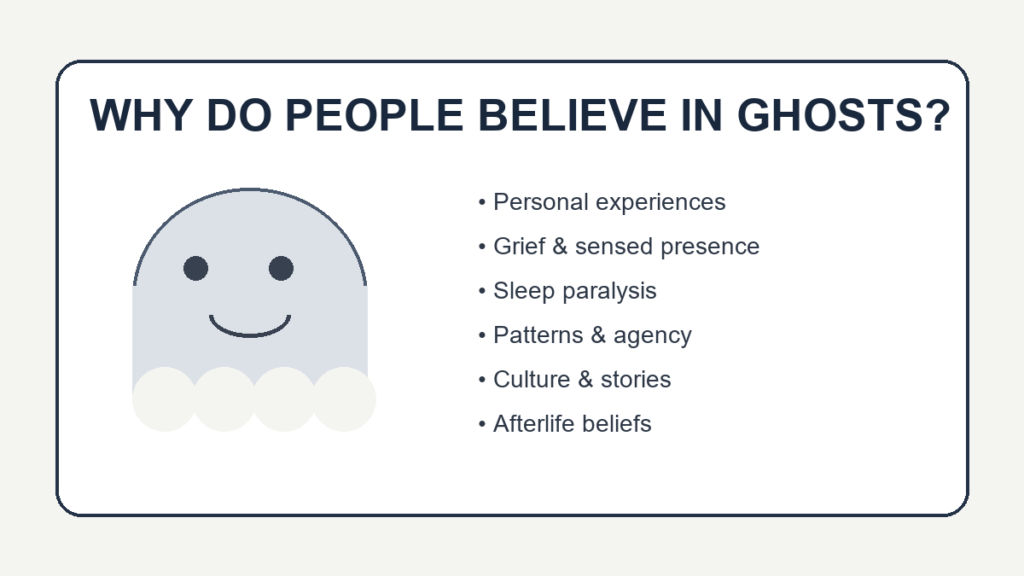
Why do people believe in ghosts? There is no single reason. Ghost belief can grow from personal experiences, grief, cultural traditions, sleep-related events, pattern detection, stories from trusted people, and a broader belief that consciousness or identity can survive death. Research can explain why ghost experiences and beliefs may feel convincing without proving that every reported experience has the same cause—or settling the larger question of whether ghosts exist.
Table of Contents
Why Do People Believe in Ghosts? The Short Answer
People believe in ghosts for a mix of psychological, social, cultural, and experiential reasons. Some people report seeing, hearing, or sensing a deceased person. Others inherit ghost beliefs through religion, family traditions, folklore, or community stories. Still others interpret unusual events—such as sleep paralysis, unexplained sounds, or coincidences—as evidence of a supernatural presence.
None of those explanations automatically proves or disproves a particular ghost claim. They explain why belief can arise and why an experience may feel persuasive.
1. Personal Experiences Can Feel Extremely Real
One of the strongest reasons people believe in ghosts is simple: they believe they have experienced one. A person may hear a voice, see a figure, feel touched, notice a strong sense that someone is nearby, or experience an event that seems too specific to dismiss.
Psychological research shows that unusual perceptions can occur in otherwise ordinary situations. That does not mean a person is lying or unintelligent. The experience itself may be vivid and sincere even when the cause is uncertain.
This distinction matters. A genuine experience is not automatically the same thing as a confirmed explanation for that experience.
2. Grief Can Include Seeing, Hearing, or Sensing the Deceased
Why do people believe in ghosts? Bereavement is one important part of the answer. Researchers have documented sensory and quasi-sensory experiences of deceased loved ones during bereavement. People may report hearing a familiar voice, catching a glimpse of the person, feeling their presence, or sensing that they are nearby.
An interdisciplinary review published in Schizophrenia Bulletin concluded that these experiences are often benign and should be understood in their personal, relational, and cultural context. Cross-cultural research also shows that societies differ in whether such experiences are viewed as comforting, normal, spiritual, frightening, or pathological.
For someone who already believes that a person’s identity can continue after death, a vivid sense of presence can naturally be interpreted as a ghost.
3. Sleep Paralysis Can Feel Like a Ghost Encounter
Why do people believe in ghosts? Sleep paralysis offers another clue. Sleep paralysis occurs when a person becomes conscious while the body remains temporarily unable to move. Episodes can include intense fear, pressure on the chest, a sensed presence, voices, shadows, figures, or other hallucination-like experiences.
Research has linked sleep paralysis with supernatural interpretations in many cultures. One study of sleep-paralysis experiences found that many participants reported a sensed presence, and some interpreted the event as seeing a ghost or spiritual being. Other research in Italy and Turkey has shown how local folklore can shape the way the same basic sleep phenomenon is understood.
For someone who does not know about sleep paralysis, waking up unable to move while sensing a figure in the room can feel like direct evidence of a supernatural visitor.
4. Humans Naturally Look for Patterns, Faces, and Intentional Agents
Human perception is designed to detect meaningful patterns quickly. That is usually useful: noticing a face, a movement, or a possible threat can matter. But the same system can sometimes find meaning in ambiguous or random information.
Studies of paranormal belief have found associations with illusory pattern perception and agency detection—the tendency to perceive purposeful agents in ambiguous situations. A 2023 study using signal detection methods found that stronger paranormal belief was associated with more false alarms when participants tried to detect meaningful visual patterns in noise.
This does not mean every strange perception is an error. It means ambiguous situations create room for interpretation, especially when a person is already considering a supernatural explanation.
5. Culture Helps Decide What an Unusual Experience Means
Why do people believe in ghosts? Culture can strongly shape the interpretation. The same experience can receive very different explanations depending on where someone grows up. A sensed presence at night might be described as a ghost, ancestor, spirit, demon, sleep problem, stress response, or vivid dream.
Anthropological and psychological research on bereavement and sleep paralysis shows that cultural expectations influence how people label and remember unusual experiences. Stories, religious teachings, rituals, television, local legends, and family beliefs all provide ready-made explanations.
Culture therefore does not necessarily create the original sensation. It can shape the story a person uses to explain it.
6. Stories From Trusted People Can Make Ghosts Seem More Plausible
Why do people believe in ghosts? Social influence matters too. People do not form beliefs in isolation. A convincing story from a parent, friend, grandparent, religious leader, or respected community member may carry more weight than a story from a stranger.
Ghost stories are also unusually memorable. They involve fear, mystery, death, identity, and unanswered questions—all subjects people naturally retell. Repetition can make an idea feel familiar, while multiple similar stories can create the impression that there must be something behind them.
This social reinforcement can work even when no single story is independently verifiable.
7. Belief in an Afterlife Makes Ghosts Easier to Accept
A ghost usually implies that some part of a person continues after bodily death. If someone already believes in a soul, spirit, consciousness after death, ancestors, reincarnation, or another afterlife framework, the idea of a ghost fits more easily into that worldview.
Someone who believes consciousness ends entirely at death begins from a very different starting assumption. That does not automatically make either person correct. It changes what each person considers plausible before evaluating a particular story or experience.
Does Believing in Ghosts Mean Ghosts Are Real?
No. Belief and evidence are different questions. Psychological research can help explain why people may believe in ghosts or sincerely report ghost experiences, but that alone does not prove that a supernatural entity caused a specific event.
The reverse is also true: finding one ordinary explanation for one alleged haunting does not prove that every ghost report has the same explanation.
A useful evidence-first approach is to ask:
- What exactly happened?
- Was anyone else present?
- Is there a recording, document, physical trace, or repeatable observation?
- Could sleep, grief, lighting, sound, memory, suggestion, or environmental conditions explain it?
- Was the explanation decided before or after the evidence was examined?
- Can independent observers verify the claim?
The same evidence-first principle applies to other unusual claims. SmallQuestions uses a similar distinction in Why Do People Believe in Conspiracy Theories?: understanding why a belief feels persuasive is not the same as establishing whether the underlying claim is true.
Frequently Asked Questions
Are people who believe in ghosts irrational?
Not necessarily. Ghost belief can come from personal experiences, cultural traditions, religious beliefs, grief, family stories, or interpretations of ambiguous events. Research finds tendencies and associations, not one personality type shared by everyone who believes in ghosts.
Why do people see ghosts after someone dies?
Bereaved people sometimes report seeing, hearing, or sensing the deceased. Research suggests such experiences can occur without indicating severe mental illness and are interpreted differently across cultures.
Can sleep paralysis make you think you saw a ghost?
Yes. Sleep paralysis can include a sensed presence, figures, voices, pressure, and intense fear. In some cultures, these episodes are commonly interpreted as supernatural attacks or ghost encounters.
Why do ghost stories exist in so many cultures?
Death, memory, grief, dreams, unusual perceptions, and beliefs about an afterlife are nearly universal human concerns. Different cultures build different traditions around those experiences.
Has science proven that ghosts do not exist?
Science has identified many ordinary mechanisms that can produce experiences people sometimes interpret as ghosts, but science does not generally prove a universal negative about every imaginable ghost claim. Specific claims can be tested according to the evidence available.
Why Do People Believe in Ghosts? Bottom Line
Why do people believe in ghosts? Because personal experiences, grief, sleep phenomena, pattern detection, culture, trusted stories, and afterlife beliefs can all make ghosts seem plausible.
The most useful distinction is between the experience, the interpretation, and the evidence. A person can sincerely experience something strange without knowing its cause. Whether a particular ghost claim is true still depends on the quality of the evidence.
Sources
- Kamp et al. — Sensory and Quasi-Sensory Experiences of the Deceased in Bereavement
- Sabucedo, Evans & Hayes — Perceiving Those Who Are Gone: Cultural Research on Post-Bereavement Perception
- Müller et al. — Linking Paranormal and Conspiracy Beliefs to Illusory Pattern Perception
- van Prooijen, Douglas & De Inocencio — Connecting the Dots: Illusory Pattern Perception and Supernatural Belief
- Dean et al. — Paranormal Beliefs and Cognitive Function: A Systematic Review
- Denis et al. — Sleep Variables, Paranormal Experiences and Paranormal Beliefs: A Scoping Review
Related questions: Similar belief questions include why people believe in astrology and why people believe in superstitions.