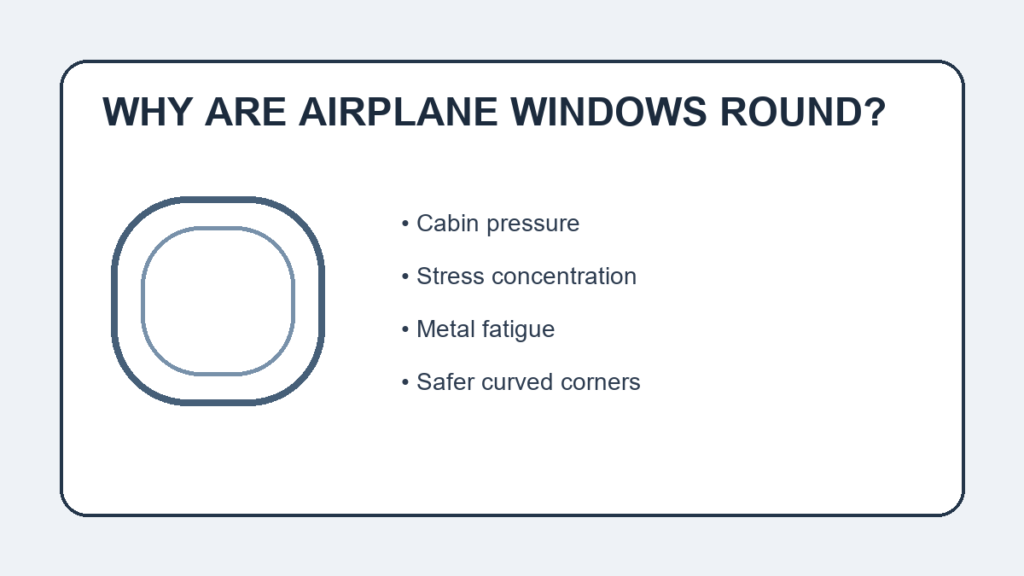
Why are airplane windows round? The short answer is structural safety. Airplane cabins are pressurized, which repeatedly puts stress on the fuselage and the openings cut into it. Rounded corners spread that stress more smoothly than sharp square corners, reducing dangerous stress concentrations and helping the aircraft withstand thousands of pressurization cycles.
Table of Contents
Why Are Airplane Windows Round? The Short Answer
Airplane windows are round or oval because curved edges distribute stress more evenly around the opening. A sharp corner creates a place where stress can build up. In a pressurized aircraft that is repeatedly climbing and descending, that extra stress can contribute to metal fatigue and cracking.
1. Pressurization Loads the Fuselage
Why are airplane windows round? Cabin pressure is the starting point. At cruising altitude, the air outside the airplane is much thinner than the air passengers breathe inside the cabin. The fuselage therefore acts like a pressure vessel.
Every flight cycle creates changing loads as the airplane climbs, pressurizes, descends, and depressurizes. The FAA requires designers to account for continuous and cyclic pressurization loads when certifying windows and surrounding structure.
For a broader explanation of how an airplane stays in the air, see How Do Airplanes Fly?.
2. Sharp Corners Concentrate Stress
Engineers use the term stress concentration for a small area where mechanical stress becomes much higher than in the surrounding material.
Sharp inside corners are classic stress concentrators. When a fuselage is pressurized, load paths have to bend abruptly around those corners. Curved corners let the load flow around the opening more gradually.
The FAA’s lessons-learned material on the early de Havilland Comet explains that squarish windows produced especially high stress concentrations, while modern round or oval shapes allow stress to flow more smoothly around the opening.
3. The de Havilland Comet Changed Aircraft Design
The de Havilland Comet was the world’s first commercial jet airliner. In the early 1950s, several Comets suffered catastrophic structural failures.
Investigators eventually found fatigue cracking associated with high stress concentrations around squarish window and hatch openings. Water-tank pressure testing and recovered wreckage helped reveal how severe the stresses were around those corners.
The Comet accidents became an important aviation-safety lesson. Modern airliner windows are not simply rounded for appearance; their shape reflects hard-earned knowledge about pressurized structures and fatigue.
4. Rounded Windows Help Reduce Fatigue Risk
Aircraft structures are designed to survive repeated loading, not just one strong load. Each pressurization cycle can contribute a tiny amount of fatigue damage over time.
Why are airplane windows round? Rounded geometry lowers the peak stress around the window frame, which helps reduce the chance that fatigue cracks will begin at a corner.
That does not mean a round window eliminates all stress. The window, frame, fuselage skin, fasteners, and surrounding structure all still have to be engineered for pressure, aerodynamic loads, temperature changes, and long service life.
5. They Are Usually Rounded Rectangles or Ovals, Not Perfect Circles
Passenger windows are often described as “round,” but many are actually ovals or rectangles with very large corner radii.
That shape gives passengers a useful viewing area while still avoiding the sharp 90-degree corners that create stronger stress concentrations. The exact geometry varies by aircraft model.
6. Airplane Windows Use Multiple Structural Layers
Passenger windows are not a single thin pane. FAA guidance describes window assemblies that can include multiple panes, structural panes, fail-safe panes, inner facing panes, air gaps, coatings, seals, and mounting structure.
The structural panes must be able to withstand cabin-pressure loads and other forces. Depending on the design, one pane may carry the normal pressure load while another provides backup if the primary structural pane fails.
The rounded opening works together with this layered construction and the surrounding frame.
7. Window Size Is a Structural Tradeoff
Any opening in a pressurized fuselage affects the structure around it. Larger openings require more reinforcement and careful engineering.
That is one reason airliner windows are relatively small compared with the side windows of a car or train. Designers balance passenger visibility, weight, manufacturing, pressure loads, fatigue life, and emergency requirements.
Modern composite aircraft can use larger windows than many older metal airliners, but the openings still retain rounded edges.
Frequently Asked Questions
Why can’t airplane windows be square?
They could be made with square-looking shapes, but sharp corners would create stronger stress concentrations. Modern designs therefore use curved corners even when the overall window looks somewhat rectangular.
Did square windows cause the Comet crashes?
The early Comet accidents involved a broader fatigue problem, but sharp-cornered openings were a major factor because they created high local stress concentrations. FAA accident lessons identify squarish windows and frames as an important part of the failure mechanism.
Are cockpit windows round?
Not always. Cockpit windshields must provide a much larger field of view, so they use different shapes. Even then, designers carefully manage structural loads, mounting, pressure, and corner geometry.
Why are airplane windows so thick?
They need to withstand pressure differences, temperature changes, impact risks, and repeated use. Passenger window assemblies typically use multiple panes rather than one thick sheet.
Why is there a tiny hole in some airplane windows?
That small opening, often called a bleed or breather hole, helps manage pressure between layers of the window assembly. Its role is different from the reason the overall window has rounded corners.
Why Are Airplane Windows Round? Bottom Line
Why are airplane windows round? Because curved edges reduce stress concentrations around a pressurized opening. That helps the fuselage handle repeated pressure cycles more safely and reduces the risk of fatigue cracks forming at sharp corners.
The shape became especially important after lessons learned from early pressurized jetliners such as the de Havilland Comet. Modern aircraft combine rounded openings with strong frames, multiple panes, and careful fatigue design.
Sources
- FAA — de Havilland DH-106 Comet 1 Lessons Learned
- FAA — AC 25.775-1: Windows and Windshields
- FAA — AC 25.775-1 PDF
- FAA — Pilot’s Handbook of Aeronautical Knowledge
- Smithsonian National Air and Space Museum — de Havilland Comet
Related questions: Continue with why airplane windows have holes and what airplane windows are made of.