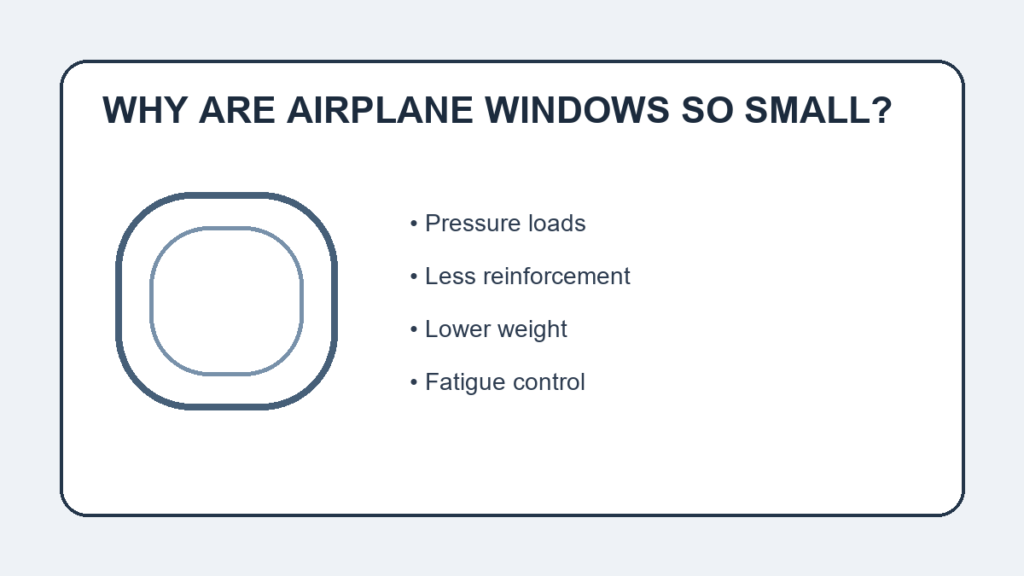
Why are airplane windows so small? The main reason is structural efficiency. Every window is an opening in a pressurized fuselage, so the structure around that opening has to carry and redistribute loads. Smaller windows make that job easier, require less reinforcement than a much larger opening, and help designers balance passenger visibility against strength, weight, fatigue life, and manufacturing complexity.
Table of Contents
Why Are Airplane Windows So Small? The Short Answer
Airplane windows are relatively small because a pressurized fuselage is strongest and lightest when it has fewer and smaller openings. Designers can absolutely make windows larger, but doing so requires more structure around the opening and can increase weight, complexity, and fatigue concerns.
1. The Fuselage Is a Pressurized Structure
Why are airplane windows so small? It starts with cabin pressure. At cruising altitude, the pressure inside the cabin is much higher than the pressure outside, so the fuselage behaves like a pressure vessel.
That pressure repeatedly loads the fuselage every time the airplane climbs and descends. FAA certification guidance requires window systems and surrounding structure to account for those pressurization loads over the aircraft’s service life.
2. Every Window Interrupts the Load Path
Why are airplane windows so small? One reason is that every opening interrupts the fuselage load path and has to be reinforced around its edges.
The fuselage skin carries structural loads around the aircraft. Cutting a window opening through that skin means those loads have to flow around the opening instead of passing straight through the material.
The surrounding frame and reinforced structure have to redistribute those loads. As the opening gets larger, the affected area grows and the surrounding structure becomes more demanding to engineer.
3. Larger Windows Need More Reinforcement
A larger opening usually needs a stronger frame and more surrounding reinforcement to maintain the same structural margin. That reinforcement adds weight, and extra weight increases fuel burn and operating cost over the life of the aircraft.
Why are airplane windows so small? Because designers are always trading passenger comfort and visibility against structural weight and efficiency.
4. Smaller Openings Help Manage Fatigue
Why are airplane windows so small? Keeping the opening smaller also reduces the structural area where repeated pressurization loads must be managed.
Aircraft structures experience repeated loading, not just one strong load. Pressurization cycles can contribute to fatigue over thousands of flights.
FAA lessons from the de Havilland Comet showed how window openings and local stress concentrations can become critical fatigue locations. Modern designs use better materials, analysis, inspection, and rounded corners, but keeping openings reasonably sized still helps limit structural demands.
5. Size and Shape Work Together
Window size is only part of the story. Shape matters too. Sharp corners concentrate stress, while rounded or oval openings spread loads more smoothly.
That is why modern passenger windows are both relatively small and rounded. For the related shape question, see Why Are Airplane Windows Round?.
6. The Window Assembly Adds Weight Too
The opening itself is not the only weight penalty. Passenger windows use multiple panes, seals, frames, spacers, and mounting hardware.
Larger windows mean larger structural panes and a larger supporting assembly. The materials must remain clear, strong, pressure-resistant, and durable over many flight cycles.
For more on the pane materials, see What Are Airplane Windows Made Of?.
7. Newer Aircraft Can Use Larger Windows
Why are airplane windows so small? Newer designs show that the answer is a tradeoff, not a hard limit: better materials and structure can support larger windows when designers accept the added engineering demands.
Some newer airliners use noticeably larger passenger windows than older designs. Advances in materials, structural analysis, manufacturing, and fuselage design can make larger openings practical without giving up required strength.
But the same tradeoffs still apply. Bigger windows are not free: engineers still have to account for reinforcement, fatigue, impact resistance, pressure loads, and weight.
Frequently Asked Questions
Why don’t airplanes just use huge windows?
Why are airplane windows so small? Because increasing the opening size increases the structural work required around that opening.
They can use larger windows, but every increase in opening size creates a bigger structural interruption in the fuselage. Larger windows generally need more reinforcement and a larger, heavier window assembly.
Are small airplane windows safer?
Window size is one factor in the overall structural design. Smaller openings are easier to reinforce efficiently, but safety depends on the complete system: materials, shape, frame design, pressure loads, fatigue analysis, inspection, and fail-safe features.
Why are airplane windows smaller than train windows?
Passenger trains do not normally maintain a large pressure difference between the inside and outside of the vehicle. Pressurized aircraft fuselages face a much more demanding structural problem, so window openings are treated differently.
Why are some modern airplane windows bigger?
New materials and improved structural design can make larger windows practical. The aircraft still has to meet the same basic strength, fatigue, and pressure requirements.
Does the tiny hole in an airplane window affect its size?
No. The small vent hole manages pressure between panes inside the window assembly. It solves a different problem from the overall size of the opening. See Why Do Airplane Windows Have Holes? for that explanation.
Why Are Airplane Windows So Small? Bottom Line
Why are airplane windows so small? Because every window is a structural opening in a pressurized fuselage. Keeping windows reasonably small reduces the amount of reinforcement and window material needed, helps manage fatigue and stress, and saves weight while still giving passengers a useful view.
Modern aircraft can use larger windows when the overall fuselage design supports them, but the basic engineering tradeoff never disappears.