
Table of contents
What are clouds? Clouds are visible masses of microscopic liquid droplets, frozen crystals, or a mixture of both suspended in the atmosphere. They appear when air becomes cool enough for invisible water vapor to change phase and collect on tiny airborne particles.
What are clouds made of?
A cloud is not made of cotton or smoke. It is made of liquid droplets, ice crystals, or a mixture of the two. Each particle is extremely small, but billions gathered together scatter sunlight so we can see the cloud. The droplets remain suspended because rising and moving air pushes against their slow fall.
Why do clouds float?
Cloud particles are light enough to stay aloft in air currents. A droplet may begin falling, but turbulence can lift it again. When many droplets merge and become heavy, they fall as precipitation. Some rain evaporates before reaching the ground, returning to invisible water vapor.
How do clouds form?
Sunlight, fronts, mountains, and thunderstorms can lift moist air. Rising air expands and cools as pressure decreases. At the dew point, water vapor changes into droplets or ice crystals. This process is called condensation. Read how clouds form step by step for a closer look.
What are the main cloud types?
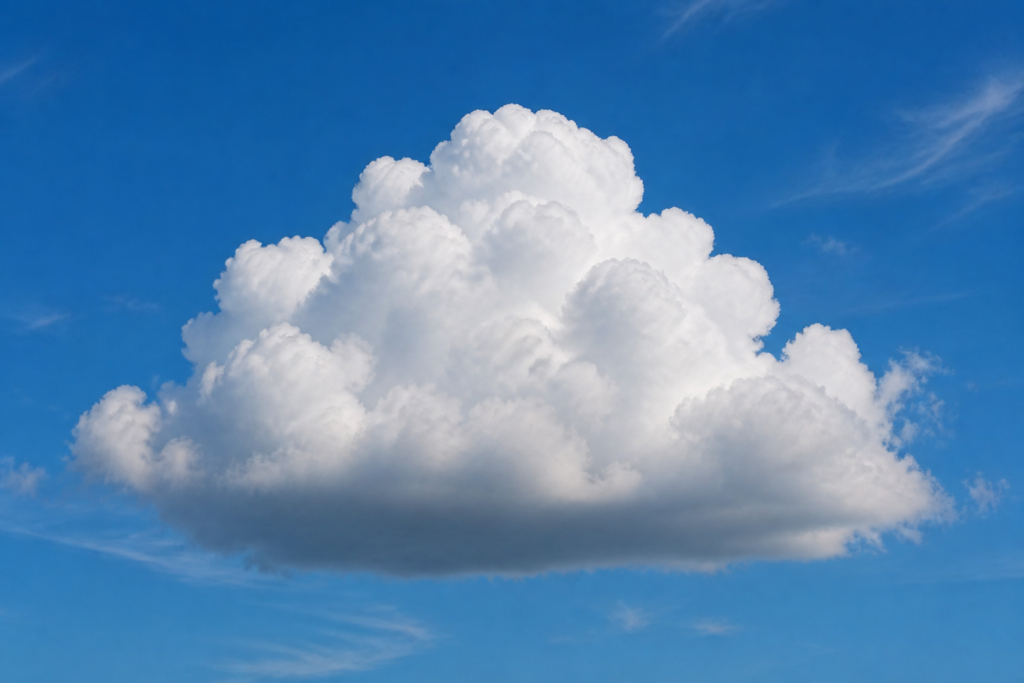
Cumulus clouds are puffy and often linked with fair weather. Stratus clouds form broad, layered sheets. Cirrus clouds are high, thin, and mostly made of ice crystals. Nimbus is used in names for clouds that produce steady rain or snow. Natural clouds can combine these patterns as conditions change.
Why do clouds change shape?
Wind stretches clouds, while evaporation thins them. New rising air can make a cloud grow taller or spread across the sky. Changes in temperature, humidity, and air movement can turn a small cloud into a thick shower cloud or make it vanish within minutes.
Are clouds heavy?
Yes. A large cloud can contain hundreds of tonnes of water, even though its droplets are spread through a huge volume of air. The water does not fall all at once because each droplet is tiny and the surrounding air keeps it suspended.
Why are some clouds white and others gray?
Thin clouds scatter sunlight and look white. Thick clouds block more light, so their undersides look gray or dark. Color can also change at sunrise and sunset when sunlight travels through more atmosphere.
Short answer
What are clouds? They are floating collections of tiny water droplets and ice crystals formed when moist air cools. Their height, shape, and thickness depend on wind, temperature, and moisture.
Clouds are constantly moving and changing even when they seem still from the ground. Wind carries them across the sky, while sunlight warms some parts and causes evaporation in others. In a rising column of air, a cloud may grow upward. In sinking air, it may flatten or disappear. Nearby mountains, lakes, forests, and cities can all affect how much moisture enters the air. This is why the same sky can look different from one neighborhood to another. Scientists use weather balloons, radar, satellites, and aircraft observations to study cloud height and movement. Watching clouds is useful because their shape and growth provide clues about humidity and stability, but a cloud alone cannot predict every change in the forecast.
Why do clouds keep changing shape?
Clouds are always moving with the wind, and the air inside them is rising, sinking, warming, or cooling. As conditions change, droplets and ice crystals can evaporate in one area and form in another. That is why a cloud can look puffy, spread into a layer, or disappear even when the weather seems calm from the ground. Sunlight, humidity, and nearby hills also influence the patterns people see.
Do all clouds make rain?
No. Many clouds are too thin or contain droplets that are too small to fall. Rain or snow develops when droplets and crystals grow large enough for gravity to overcome rising air. Thick clouds with strong upward movement are more likely to produce precipitation, but cloud appearance alone cannot predict every shower.
Knowing what are clouds helps explain why the sky can look different from hour to hour. If you wonder what are clouds during a humid day, look for condensation where rising air cools.
Sources
- NOAA JetStream: Clouds
- UCAR Center for Science Education: Clouds
- National Weather Service: Cloud science
Why clouds can look white, gray, or dark
Cloud droplets and ice crystals scatter sunlight in many directions. A small or thin cloud can look bright white because plenty of sunlight passes through and is scattered toward your eyes. A thicker cloud contains a longer path through droplets or crystals, so less direct light reaches the underside. That can make the base look gray or very dark even though the cloud itself is still made of tiny water droplets, ice crystals, or both.
The color you see also depends on the sun’s position and what surrounds the cloud. Near sunrise or sunset, clouds can appear orange, pink, or red because sunlight has traveled through more of the atmosphere before reaching them. Shadows from other parts of a cloud can create dramatic differences within the same cloud.
To see how these droplets get into the sky, read how clouds form. Fog is closely related, so the difference between fog and clouds is a useful companion explanation.
Cloud appearance is therefore a clue to thickness, lighting, and structure, but color by itself does not identify a particular type of cloud. Shape, altitude, and weather conditions are also important.