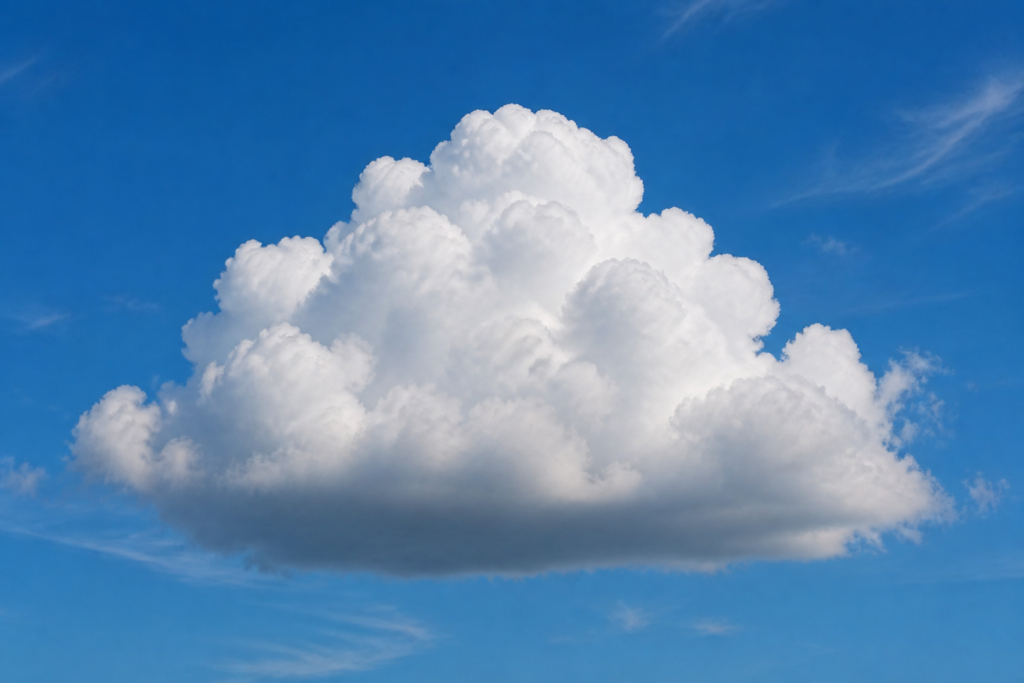
What is the difference between fog and clouds? The key difference is location: fog is a cloud that forms at or very near the ground, while ordinary clouds float above the surface. Both form when moist air cools enough for water vapor to condense into tiny droplets or ice crystals.
Table of contents

Short answer
Fog and clouds are made of the same basic thing: tiny water droplets or ice crystals suspended in air. The main difference is where they form. A cloud stays above the ground, while fog is a cloud that reaches the ground or lies very close to it.
How clouds form
Clouds appear after humid air reaches saturation. At that point, some water vapor changes into microscopic liquid droplets or ice crystals on particles already floating in the air. Those particles scatter light, making the collection visible. Depending on temperature and air motion, the cloud may develop close to the surface, in a broad middle-level layer, or high in the cold upper atmosphere.
How fog forms
Fog forms through the same condensation process, but the air cools or gains moisture at ground level. Common types include radiation fog, which develops when the ground loses heat on a clear, calm night, and advection fog, which forms when warm, moist air moves over a colder surface. Valley fog can collect in low areas, while evaporation fog may appear when cold air passes over warmer water.
Why fog reduces visibility
Fog contains many droplets close to eye level. They scatter headlights and sunlight in many directions, making distant objects hard to see. Visibility can fall below one kilometer in dense fog. Drivers should slow down, use the correct lights, leave extra space, and follow local safety guidance when visibility is poor.
Can fog become a cloud?
Fog can lift and become a low cloud when the air near the ground warms or mixes with drier air. The droplets may evaporate, causing the fog to disappear, or the entire layer may rise above the surface. From a mountaintop, a person may even stand inside a cloud that looks and feels like fog at ground level.
Fog, mist, and haze
Mist is similar to fog but usually allows better visibility. Haze is different: it is caused mainly by tiny dry particles such as dust, smoke, or pollution rather than liquid water droplets. Weather services use visibility measurements and local conditions to distinguish these terms.
What is the difference between fog and clouds when you look up from the ground? Fog stays at the surface, while clouds have a base above it. For more background, read what clouds are made of and what a stratus cloud is.
The difference between fog and clouds can change during the day as air warms, cools, or moves. What is the difference between fog and clouds in a valley? The same rule applies: the low cloud is called fog when it touches the ground.
What is the difference between fog and clouds in the morning? Fog is the cloud layer touching the surface. What is the difference between fog and clouds from a hilltop? The elevated observer may be inside a cloud while the valley below remains foggy.
When does a low cloud count as fog?
The practical distinction is whether the cloud base reaches the surface. A low stratus cloud may hover just above the ground, while fog is the same kind of suspended droplets at ground level. Wind, cooling, warming, and changing humidity can make the boundary rise or fall during the day.
That is why the same moist air layer can be described differently from different elevations. A person in a valley may be standing in fog while someone on a nearby hillside sees a low cloud layer below.