
Why are tennis balls fuzzy? Their felt covering affects how air flows around the ball, how the ball responds to spin, and how its surface wears during play. The fuzz is a functional part of a tennis ball, not just a distinctive texture.
Why are tennis balls fuzzy instead of smooth?
To understand why tennis balls are fuzzy, start with the materials: a tennis ball has a rubber core covered in woven felt. The short fibers standing above that fabric are often called the nap. Those fibers make the ball’s surface different from a smooth rubber sphere.
As the ball travels, air pushes against it. This is aerodynamic drag, a force that resists movement. The felt and its loose fibers change that drag. Researchers studying tennis-ball aerodynamics have found that felt texture, fiber length, and how the ball spins all influence its flight. In ordinary play, this helps explain why a tennis ball does not travel like a smooth rubber ball of the same size.
For another example of how air moves around objects, see our explanation of how airplanes fly.
The Children’s Museum of Indianapolis offers an accessible explanation of how fuzz adds resistance and helps players control the ball. For a more technical explanation, see the research review Review of Tennis Ball Aerodynamics.
1. Tennis-ball fuzz changes air resistance
When a ball flies through the air, the air has to move around its surface. The irregular felt covering disturbs that flow. It also changes the wake, the region of moving air behind the ball.
This is more complicated than saying that each fuzzy fiber simply rubs against air. The way air separates from the ball and the way fibers interact with airflow both matter. The amount of drag also depends on the ball’s speed, its spin, and the state of the felt.
In practical terms, two tennis balls with different felt conditions may not travel in exactly the same way even if struck similarly.
2. Fuzz affects topspin and backspin
Players use topspin to make shots dip toward the court and backspin, sometimes called slice, to produce a different flight and bounce. Why are tennis balls fuzzy if a player already puts spin on the shot? A spinning ball interacts with the air around it, creating aerodynamic forces that change its trajectory.
That is another reason why tennis balls are fuzzy: the felt surface helps determine those aerodynamic effects. That does not mean all spin comes from the fuzz: the racket strike starts the rotation, while airflow influences what happens afterward.
Tennis-ball researchers study the combined effects of speed, rotation, and surface texture rather than treating fuzz and spin as separate subjects.
3. Felt also matters when the ball bounces
A tennis ball does not move only through the air. It repeatedly contacts racket strings and the court. The felt is the outermost surface during those contacts.
The ball’s rubber core is important for its bounce, while the felt can affect friction and how the ball grips or slides on a surface. Court materials, speed, and the angle of impact also matter. A ball struck with heavy topspin can therefore bounce differently from a flatter shot.
It would be misleading to say that fuzz alone creates bounce. The core, pressure, spin, and playing surface all contribute.
4. Why does tennis-ball fuzz wear away?
A ball hits hard surfaces hundreds of times during repeated play. Contact with racket strings and court surfaces can loosen, flatten, or wear down the felt fibers.
That is why a ball may look fluffier after initial play and later look worn or patchy. As the covering changes, its aerodynamic behavior can change too. The rubber core and its pressure may also change with use, so a worn tennis ball can feel different for more than one reason.
This changing texture is part of the answer to why tennis balls are fuzzy, and replacing old balls is partly about keeping equipment performance consistent.
5. What is tennis-ball fuzz made of?
Tennis-ball coverings are made from textile felt. Formulations differ by manufacturer and product, but wool and synthetic fibers such as nylon are commonly used. The precise mix is not the same in every ball.
The fabric is shaped and bonded around the rubber core, creating the curved seam seen on a tennis ball. Understanding how this fabric is made helps explain why tennis balls are fuzzy. The fuzzy texture is a property of the fabric’s raised fibers, not loose hair glued individually onto the ball.
For a materials-oriented discussion, read SGS Polymer Solutions’ explanation of tennis-ball fuzz.
6. Would a smooth tennis ball work?
Why are tennis balls fuzzy instead of smooth? A smooth rubber ball could be hit over a net, but it would not behave exactly like a regulation felt-covered tennis ball. Its movement through the air, interaction with the court, and response to spin would differ.
That difference is why the felt is part of the ball’s engineering. A useful comparison would have to use balls with matching size, mass, core, and pressure, varying only the covering. Otherwise differences in bounce could incorrectly be blamed on fuzz. For a different example of how physical design helps objects behave as expected, read our explanation of why airplane windows are round.
7. Does the fuzz make every tennis ball equally slow?
No. How a ball travels depends on much more than the amount of fuzz you can see. Speed, spin, pressure, and wear all influence the result.
Different playing conditions can also change how fast a ball appears to move. The most accurate answer is not that a fuzzy ball always flies at one predictable speed, but that its covering helps determine the way it responds to the air.
What happens to the air around a fuzzy tennis ball?
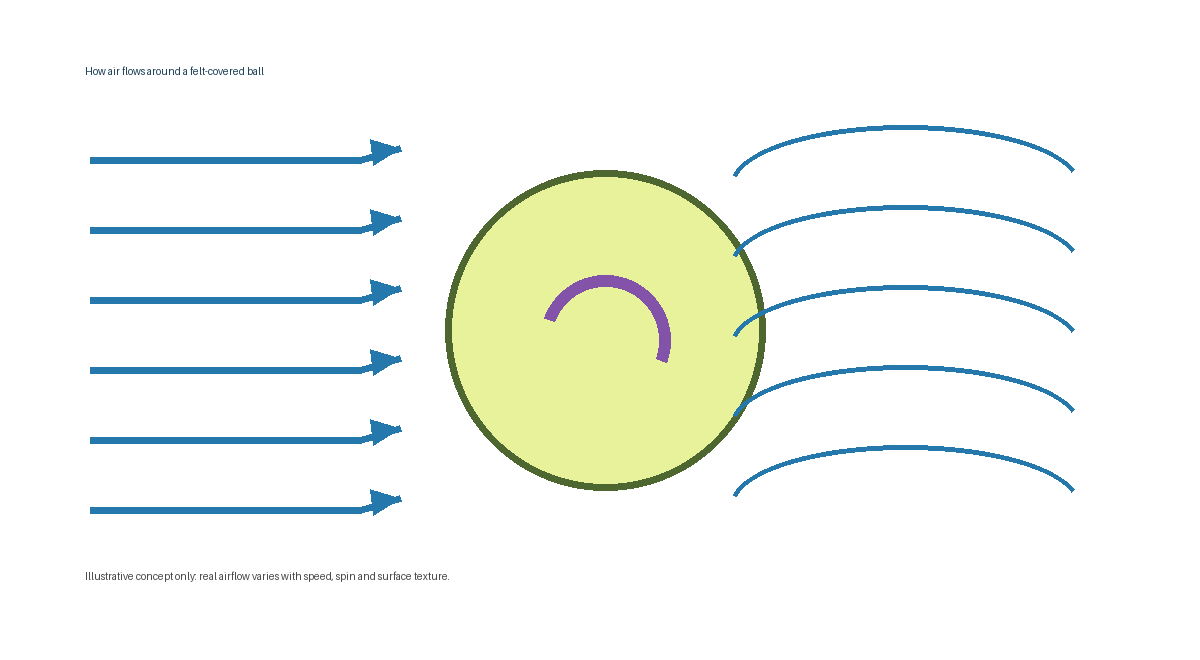
Imagine taking a photo of a tennis ball in flight. You could see its position, but not the complex movement of air around it. Air near the front of the ball must move sideways, and air behind it forms a wake. The felt and the fibers rising from it affect this process.
That is why scientists talk about more than the simple idea that fuzz makes a ball slow. The flow around a spinning ball changes with speed, rotation, and surface condition. A new ball, a slightly worn ball, and a heavily scuffed ball may have different aerodynamic behavior. Measuring those differences requires controlled experiments; appearance alone cannot tell you precisely how much drag a ball produces.
There is also an important distinction between drag and lift. Drag works against a ball’s forward travel. Lift is the aerodynamic force perpendicular to that direction; for a spinning tennis ball, its direction depends on the spin. Both matter to the curved flight that players see.
Why do courts and ball condition matter together?
When a tennis ball lands, the result depends on several things happening at once. The rubber core deforms and recovers, while the felt contacts the court. Friction, speed, landing angle, and spin can all influence how the ball rebounds. A dusty or worn covering may interact differently with the surface, but the felt is not the only variable.
This is why it is difficult to compare two shots simply by looking at the amount of visible fuzz. If one ball has lost pressure or one shot has more spin, those differences can change the bounce independently of the felt. A fair experiment would control the ball’s core and pressure, launch speed, rotation, and court surface before comparing coverings.
Does more visible fuzz always mean more control?
Not necessarily. Visible fuzz is only a rough clue to the condition of the felt. Fibers may stand up after impacts, flatten under repeated contact, or wear away. The aerodynamic effects depend on how the surface interacts with moving air, not just how fluffy it looks in a photograph.
Players control shots mainly through their racket contact, aim, and the spin and speed they produce. The ball’s felt helps determine what happens afterward. That distinction explains both why tennis balls need their textile covering and why replacing a worn ball can make play feel more consistent.
Frequently asked questions
Why are tennis balls fuzzy and why can their felt fluff up during a match?
Repeated impacts can lift and disturb the fibers in the felt. With continued wear, some fibers can flatten or break away. The appearance and behavior of the ball may therefore change during play.
Why are tennis balls fuzzy if the rubber core makes them bounce?
Not by itself. The elastic rubber core and internal pressure play major roles. Felt affects the surface interaction but is not the only factor.
Why are tennis balls fuzzy: is the covering just for looks?
No. Why are tennis balls fuzzy? Their texture affects airflow and how the ball interacts with the court and racket.
Are tennis balls covered in real hair?
No. The fuzzy coating is textile felt made from fibers such as wool or synthetics, depending on the ball.
Why are tennis balls fuzzy? The simple answer
Tennis balls are fuzzy because their felt covering helps shape their flight, spin, and contact with playing surfaces. The texture makes a tennis ball behave differently from a smooth rubber sphere, while the core supplies much of its bounce.
The next time you ask, “Why are tennis balls fuzzy?”, look at how that felt changes through a match. Rising or wearing fibers are small changes in a carefully designed piece of sports equipment.
Sources: Children’s Museum of Indianapolis, Review of Tennis Ball Aerodynamics, and SGS Polymer Solutions.