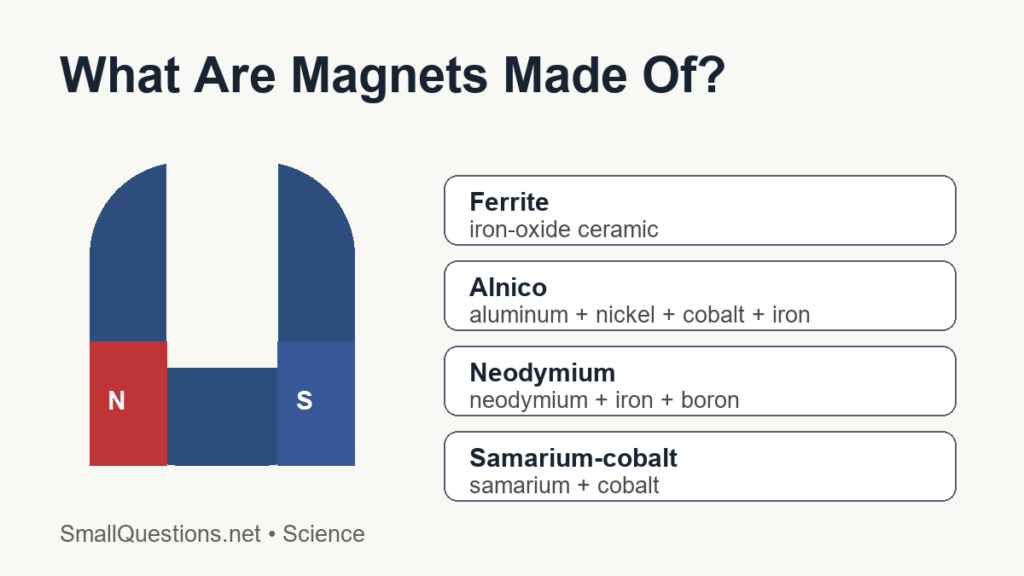
What are magnets made of? Magnets are made from materials that can produce and hold a magnetic field. Common permanent magnets are made from ferrite ceramics, alnico alloys, neodymium-iron-boron, or samarium-cobalt. Some flexible magnets mix magnetic powder with rubber or plastic so the magnet can bend.
Table of Contents
What Are Magnets Made Of?
There is no single material used for every magnet. The right material depends on how strong the magnet must be, how much heat it needs to tolerate, how much it can cost, and whether it needs to be rigid or flexible.
Many useful magnetic materials contain iron, nickel, cobalt, or combinations of those elements with other materials. NIST notes that iron, nickel, and cobalt are common ferromagnetic elements, meaning they can develop a strong internal magnetic order. Modern permanent magnets often use carefully designed compounds and alloys rather than a single pure metal.
The Main Materials Used to Make Magnets
Most permanent magnets you encounter fit into a few major families:
- Ferrite or ceramic magnets. These are commonly made from iron oxide combined with compounds containing barium or strontium. They are inexpensive, resist corrosion well, and are widely used in speakers, motors, crafts, and household products.
- Alnico magnets. The name comes from aluminum, nickel, and cobalt. Alnico magnets also contain a large amount of iron and may include smaller amounts of other elements. They are known for working well at relatively high temperatures.
- Neodymium magnets. These powerful rare-earth magnets are primarily made from neodymium, iron, and boron, often written as NdFeB. They are used where a strong magnetic field is needed in a small space.
- Samarium-cobalt magnets. These rare-earth magnets combine samarium and cobalt. They can keep useful magnetic properties at temperatures that would weaken some other magnets.
- Flexible magnets. Many flexible sheets and strips mix ferrite magnetic powder with rubber, vinyl, or another polymer binder. The binder makes the finished material bendable.
Are All Magnets Made of Metal?
No. Some magnets are metallic alloys, but others are ceramic materials or composites. Ferrite magnets, for example, are ceramic-like materials based on iron oxide. Flexible magnets combine magnetic particles with a nonmetallic binder.
That is why the simple answer “magnets are made of metal” is incomplete. Metal is important in many magnets, but the exact recipe can include ceramics, rare-earth compounds, and plastics or rubber.
Why Do These Materials Become Magnetic?
Inside certain materials, tiny magnetic effects associated with electrons can line up in regions called magnetic domains. In an ordinary piece of unmagnetized material, many domains may point in different directions, so their effects partly cancel.
When a suitable material is magnetized, more of those domains line up in the same general direction. “Hard” magnetic materials resist losing that alignment, which is why they can remain permanent magnets after the external magnetizing field is removed.
Temperature also matters. Heating a magnetic material enough can disturb the ordered state that produces strong magnetism. NIST demonstrates this with magnetic steel: when heated above a critical temperature, it loses its strong magnetic behavior, then regains it as it cools.
What Are Neodymium Magnets Made Of?
Neodymium magnets are made mainly from neodymium, iron, and boron. The material is commonly called NdFeB. The U.S. Department of Energy identifies neodymium-iron-boron as one of the major rare-earth permanent-magnet materials used in high-performance applications.
These magnets can be extremely strong for their size. They appear in products such as electric motors, headphones, hard drives, generators, and many compact electronic devices. Manufacturers may add small amounts of other elements or coatings to improve temperature performance, corrosion resistance, or durability.
What Are Refrigerator Magnets Made Of?
Many flat refrigerator magnets are flexible magnets. They usually contain ferrite magnetic powder mixed into rubber or plastic. The material is magnetized in a pattern that lets one face grip a steel refrigerator door while the strip remains flexible.
Small rigid decorative refrigerator magnets may instead use a ceramic ferrite magnet or a small neodymium magnet attached to the decoration.
Are Electromagnets Made Differently?
Yes. An electromagnet produces its magnetic field when electric current flows through a coil of wire. Many electromagnets use copper wire wrapped around an iron or steel core. The core strengthens the magnetic field, but the magnetism can be switched on or off by controlling the current.
That makes an electromagnet different from a permanent magnet, which is designed to keep its magnetization without a continuous electric current. For the electrical side of the story, see What is electricity? and What is static electricity?.
What Metals Are Magnetic?
Iron, nickel, and cobalt are the best-known ferromagnetic elements at ordinary temperatures. However, whether an everyday object is attracted strongly to a magnet depends on its exact composition and structure. Some steels are strongly magnetic, while some stainless steels are only weakly magnetic or are effectively nonmagnetic in normal use.
Frequently Asked Questions
What is the strongest common type of permanent magnet?
Neodymium-iron-boron magnets are among the strongest commercially common permanent magnets by size. Their high magnetic strength is why they are widely used in compact motors, electronics, and generators.
Are magnets made from iron?
Many are. Iron is part of ferrite magnets, neodymium-iron-boron magnets, alnico alloys, and many magnetic steels. But iron is not the only ingredient, and some magnet types depend heavily on cobalt, nickel, samarium, neodymium, or ceramic compounds.
Can any piece of metal become a permanent magnet?
No. A material must have the right magnetic properties and structure to become a useful permanent magnet. Copper and aluminum, for example, do not behave like iron or common permanent-magnet materials.
The Short Answer
What are magnets made of? Common magnets are made from ferrite ceramics, iron-based alloys such as alnico, rare-earth compounds such as neodymium-iron-boron and samarium-cobalt, or flexible mixtures of magnetic powder and rubber or plastic. The material is chosen for the strength, temperature range, durability, and cost needed for the job.