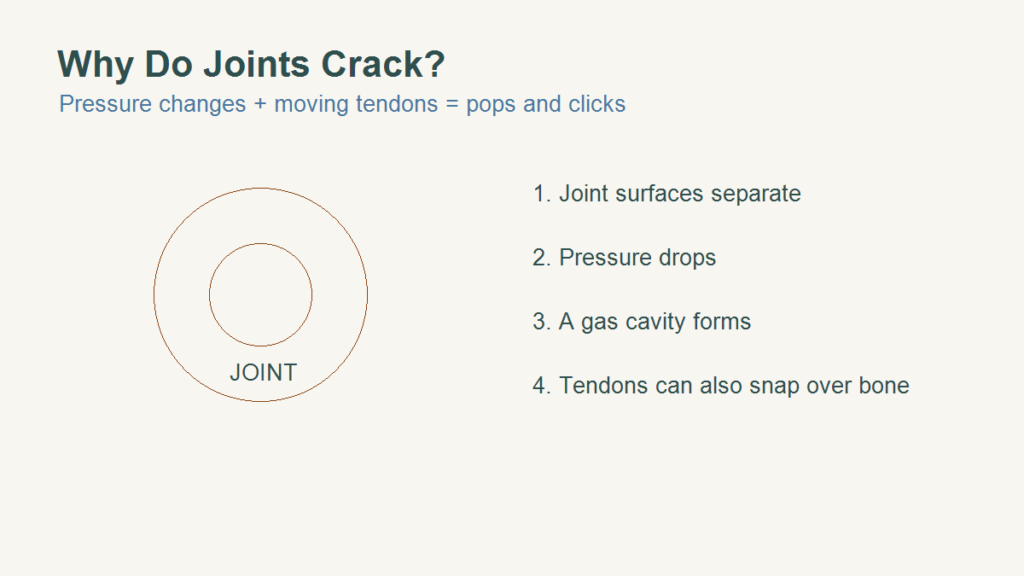
Why do joints crack? Joints can crack, pop, or snap for several ordinary reasons. The most familiar knuckle-cracking sound comes from rapid pressure changes in synovial fluid that create a gas cavity inside the joint. Other noises can come from tendons or ligaments moving over bone, or from rougher joint surfaces rubbing during movement.
Most painless joint noises are common and are not automatically a sign that something is wrong.
Table of Contents
Why Do Joints Crack?
Many movable joints contain synovial fluid, a slippery liquid that helps reduce friction between joint surfaces. That fluid contains dissolved gases. When you pull, bend, or stretch a joint in a way that rapidly lowers pressure inside the joint space, a gas-filled cavity can form. The sudden change can produce the familiar cracking sound.
Scientists once commonly described this as a bubble collapsing. Modern imaging research suggests the sound is associated with the rapid formation of a cavity in the joint fluid, a process called tribonucleation.
Do Gas Bubbles Cause the Sound?
Gas is involved, but the simple phrase “a bubble pops” is not quite accurate. When joint surfaces separate quickly, pressure in the synovial fluid falls. Dissolved gases can come out of solution and a cavity forms rapidly. That fast event creates vibration and sound.
Afterward, the same joint usually cannot be cracked again immediately. It takes time for the gases and pressure conditions inside the joint to return to a state where another crack can occur.
What About Tendons and Ligaments?
Not every click or pop comes from synovial fluid. Tendons and ligaments can shift slightly as a joint moves, then snap back over a nearby structure. This can create a clicking or popping sound, especially around the knees, ankles, shoulders, and hips.
Some joints also make grinding or crackling sounds known as crepitus. Crepitus can happen for harmless reasons, but it can also occur when joint surfaces are rougher than usual.
Why Can You Crack Your Knuckles?
Knuckles are synovial joints, so pulling or bending a finger can quickly change the pressure inside the joint capsule. When the joint surfaces separate enough, a cavity forms in the synovial fluid and you hear a crack.
The sound itself is surprisingly loud for such a small space because the pressure change happens very quickly.
Does Cracking Joints Cause Arthritis?
Research has not shown that ordinary knuckle cracking causes osteoarthritis. Several studies have looked for a connection and have not found a meaningful increase in arthritis among habitual knuckle crackers.
That does not mean every joint noise should be ignored. A new crack or pop that comes with pain, swelling, locking, loss of motion, or an injury is different from painless everyday joint noise.
Why Do Joints Crack More as You Get Older?
Joint tissues change with age. Cartilage can become less smooth, tendons and ligaments can become stiffer, and movement patterns can change. Those changes can make clicks, pops, and crackles more noticeable even when they are not painful.
Frequently Asked Questions
Why do my joints crack when I stand up?
Changing position can move tendons, ligaments, and joint surfaces quickly. That movement can create harmless pops or clicks, especially after you have been still for a while.
Why can’t I crack the same knuckle twice in a row?
After a knuckle cracks, the joint fluid needs time to return to the pressure and gas conditions that allow another cavity to form.
Is painless joint cracking normal?
Yes, painless popping and cracking are very common. Pain, swelling, or loss of motion are more important warning signs than the sound alone.
The Short Answer
Why do joints crack? The sound usually comes from rapid pressure changes and cavity formation in joint fluid, or from tendons and ligaments moving over nearby structures. Painless cracking is common and usually harmless.
For more Human Body questions, read why ears pop, why fingers wrinkle in water, or browse the Human Body section.