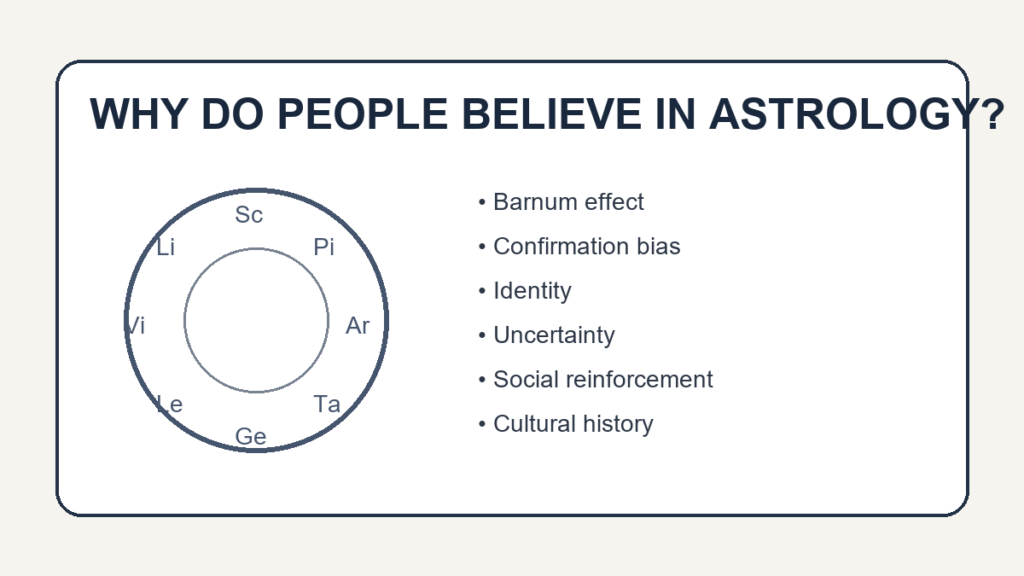
Why do people believe in astrology? There is no single reason. Astrology can feel convincing because it offers personality descriptions that seem personally accurate, gives people a framework for uncertainty, encourages selective attention to “hits,” reinforces identity and relationships, and has deep cultural roots. Psychological research helps explain why astrological readings can feel meaningful even when the claims themselves have not been scientifically validated.
Table of Contents
Why Do People Believe in Astrology? The Short Answer
People believe in astrology for a mix of cognitive, emotional, social, and cultural reasons. Horoscopes often use broad personality statements that many people can recognize in themselves. Once a person expects astrology to be meaningful, they may remember accurate-seeming predictions more strongly than inaccurate ones and interpret ambiguous events in ways that fit the reading.
That does not mean people who enjoy astrology are gullible or irrational. These are ordinary psychological processes that affect everyone in different settings.
1. General Statements Can Feel Surprisingly Personal
One of the best-known explanations is the Barnum effect, also called the Forer effect. It describes the tendency to accept vague, generally applicable personality statements as uniquely accurate descriptions of ourselves.
For example, a statement such as “You value independence but also want approval from others” can fit a very large number of people. Yet when someone believes the statement was generated specifically for them, it can feel highly personal.
The American Psychological Association defines the Barnum effect as the tendency to believe vague predictions or personality descriptions—such as those used in astrology—apply specifically to oneself. This is one reason horoscope language can feel accurate without needing to be uniquely tailored.
2. People Remember the Hits More Than the Misses
Why do people believe in astrology? Confirmation bias is another important part of the answer. Once someone expects a horoscope or birth chart to be meaningful, they may pay more attention to events that seem to confirm it and less attention to events that do not.
If a horoscope predicts conflict and one disagreement happens that day, the prediction may feel validated. If the rest of the day is uneventful, those hours may not stand out in memory.
Research on self-attribution and astrology has also found that people who know what traits are supposedly linked to their sign may remember behavior that fits those expectations more readily than behavior that contradicts them.
3. Astrology Can Become Part of a Person’s Identity
Why do people believe in astrology? Identity is part of the answer. Astrology can offer ready-made language for describing personality, relationships, strengths, weaknesses, and compatibility. Saying “I’m a Virgo” or “She’s such a Leo” can become a shorthand way of talking about identity.
Identity systems are useful because they simplify complex social information. They can help people explain themselves, compare experiences, and feel understood. Even when the categories are broad, they can provide a sense of coherence.
This is similar to why personality quizzes, typologies, and labels can feel satisfying. They turn a complicated person into a simpler story that is easier to discuss.
4. Astrology Can Make Uncertainty Feel More Manageable
Why do people believe in astrology? Uncertainty matters too. Life contains a great deal of uncertainty: relationships, work, health, money, timing, and major decisions can all feel unpredictable. Astrology offers a framework that appears to organize that uncertainty into cycles, signs, houses, and patterns.
Having a framework can feel comforting even when it does not reliably predict outcomes. A system that gives events meaning may reduce the feeling that life is random or uncontrollable.
This does not mean everyone turns to astrology because they are distressed. It means systems that provide explanation and structure can become more appealing when people are trying to make sense of complicated events.
5. Friends, Social Media, and Communities Reinforce Astrology
Why do people believe in astrology? Social reinforcement matters. Beliefs become more familiar when they are repeated by people we trust. Astrology is especially social: people compare signs, share memes, discuss compatibility, post charts, and explain behavior using astrological language.
That repeated exposure can make the system feel normal and intuitive. It also creates a feedback loop. If friends regularly interpret events through astrology, each new story can become another example that seems to confirm the system.
Social reinforcement does not prove the underlying claims, but it can make them feel more credible and memorable.
6. Expectations Can Shape How People See Themselves
Astrology can influence self-perception even if the astrological prediction itself is not causally correct. Researchers have found that people who know the traits supposedly associated with their zodiac sign may describe themselves in ways that fit those expectations.
This is sometimes called self-attribution. If a person repeatedly hears that their sign is impulsive, practical, emotional, or ambitious, that label may influence what they notice and remember about their own behavior.
Over time, the belief can become partly self-reinforcing: the person expects a trait, notices examples of it, and then treats those examples as proof that the original description was accurate.
7. Astrology Has Deep Cultural and Historical Roots
Why do people believe in astrology? History and culture also matter. Astrological traditions are ancient. Systems connecting celestial movements with human events developed in several civilizations and were woven into religion, calendars, medicine, politics, and philosophy.
Long history can give a belief system cultural legitimacy. If generations of people have used a system, it may feel more credible than a newly invented claim—even when age by itself does not establish scientific validity.
Modern astrology also benefits from constant visibility in newspapers, apps, social media, entertainment, and popular culture. That keeps the vocabulary familiar even for people who do not consider themselves strong believers.
Does Astrology Actually Work?
This is a different question from why people believe in astrology. Psychological research can explain why astrology feels accurate or meaningful, but the truth of astrological claims depends on whether those claims hold up under controlled testing.
Major psychological references classify astrology as a pseudoscience because there is no reliable evidence that planetary positions determine personality or predict life events in the way astrology claims. Large-scale tests and controlled studies have generally failed to show predictive accuracy beyond what would be expected from chance, broad descriptions, self-attribution, or other psychological effects.
That does not mean astrology has no personal or cultural value. People may use it for reflection, entertainment, storytelling, identity, or social connection. The key distinction is between meaning and evidence.
The same distinction appears in other belief systems discussed on SmallQuestions. See Why Do People Believe in Conspiracy Theories? and Why Do People Believe in Ghosts?.
Frequently Asked Questions
Why do horoscopes feel so accurate?
Horoscopes often use broad statements that can fit many people. The Barnum effect helps explain why readers may experience those statements as uniquely accurate.
Is astrology the same thing as astronomy?
No. Astronomy is a science that studies celestial objects and physical processes in space. Astrology is a belief system that interprets celestial positions as influencing personality and human events.
Why do smart people believe in astrology?
Intelligence does not eliminate cognitive biases. The Barnum effect, confirmation bias, social reinforcement, and self-attribution are ordinary human tendencies that can affect people across many levels of education and ability.
Can astrology influence someone’s personality even if it is not scientifically valid?
It can influence self-perception. If someone strongly identifies with the traits assigned to their sign, those expectations may affect how they describe and remember their own behavior.
Why has astrology stayed popular for so long?
It combines history, identity, storytelling, uncertainty reduction, and social interaction. Those features can keep it culturally relevant even without scientific support for its predictive claims.
Why Do People Believe in Astrology? Bottom Line
Why do people believe in astrology? Because astrology can feel personally accurate, provide structure, reinforce identity, fit social expectations, and benefit from cognitive processes such as the Barnum effect and confirmation bias.
Those mechanisms explain why astrology can feel convincing. They do not by themselves prove that astrological predictions are true. Whether a claim is scientifically supported still depends on controlled evidence.
Sources
- American Psychological Association — Barnum Effect
- American Psychological Association — Astrology
- Mikušková & Čavojová — The Effect of Analytic Cognitive Style on Credulity
- Rodríguez-Ferreiro et al. — Educational Intervention, Causal Illusions and Paranormal Beliefs
- Genus — The Validity of Astrological Predictions on Marriage and Divorce
- Hamilton — Introversion-Extraversion: Astrology Versus Psychology