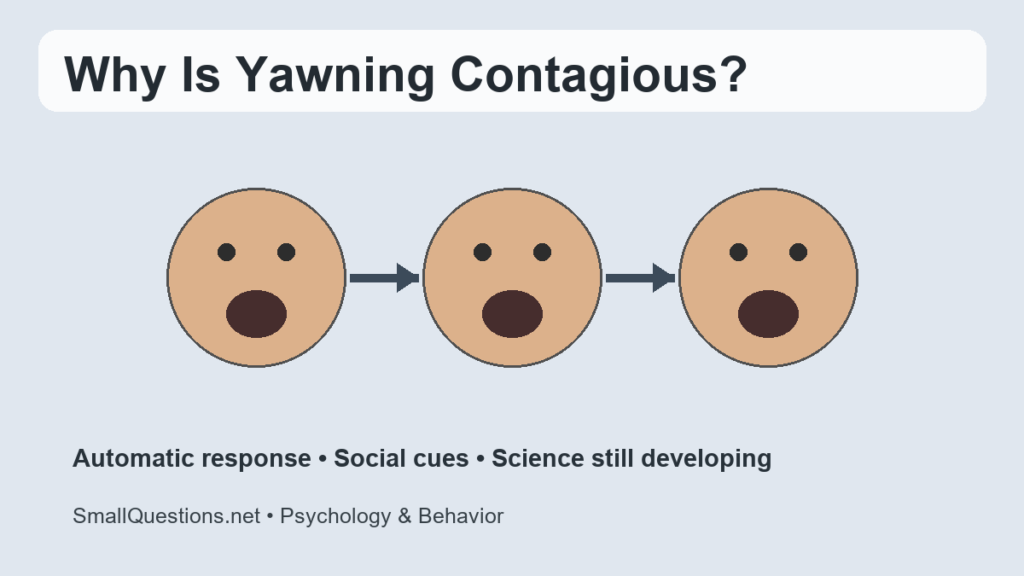
Why is yawning contagious? Seeing another person yawn can trigger a yawn of your own, and sometimes even hearing, reading, or thinking about yawning can do it. Scientists call this contagious yawning. Researchers know the effect is real, but there is still no single proven explanation for exactly why it happens.
Table of Contents
Why Is Yawning Contagious?
Contagious yawning is an automatic response in which a yawn is triggered by another yawn or by a cue related to yawning. Scientists have documented the behavior, but its ultimate purpose is still debated.
Several explanations have been proposed. Contagious yawning may involve attention to other people, automatic imitation, social coordination, brain networks involved in observing actions, or physiological effects associated with yawning itself. These ideas are not all mutually exclusive.
So the most accurate answer to why is yawning contagious is that our brains can automatically respond to yawn-related cues, while researchers are still working out exactly why that response exists.
What Can Trigger a Contagious Yawn?
Watching another person yawn is the obvious trigger, but it is not the only one. Experiments and everyday experience suggest that videos, pictures, sounds, and even thoughts about yawning can sometimes produce the response.
That is one reason an article about yawning can make readers start yawning. Your brain does not necessarily need to see a tired person standing in front of you to respond to the idea of a yawn.
Does Contagious Yawning Mean You Are Empathetic?
You may have heard that catching someone’s yawn proves that you are empathetic. The evidence is more complicated than that.
Some studies have reported relationships between contagious yawning and measures of social connection or empathy. Other research has questioned whether empathy is the main explanation. Age, attention, individual differences, and the experimental setup can also affect whether someone yawns.
It is therefore better not to use a caught—or uncaught—yawn as a personality test. A person who does not yawn after seeing someone else yawn has not automatically failed an empathy test.
What Happens in the Brain When a Yawn Spreads?
Researchers have used brain imaging and other methods to study what happens when people observe yawns. The results point toward networks involved in observing actions, attention, and automatic responses, but there is no simple “yawn center” that completely explains contagious yawning.
The response also feels involuntary for a reason. You can sometimes resist a yawn, but the urge can appear before you consciously decide to imitate anyone.
Could Yawning Help Regulate Brain Temperature?
One scientific hypothesis proposes that yawning may help with brain thermoregulation—the regulation of brain temperature. Under this idea, the physical act of yawning and related changes in blood flow and breathing could help cool the brain under some conditions.
This hypothesis has generated research, including work examining how ambient temperature affects yawning. It does not, however, mean scientists have proved that brain cooling is the complete explanation for contagious yawning.
Does Everyone Catch Yawns?
No. People differ greatly in how susceptible they are to contagious yawning. One person may yawn almost immediately after seeing someone yawn, while another may feel nothing.
Susceptibility can also change with age, attention, tiredness, and circumstances. Because so many factors can influence the response, a single yawn tells you very little about a person’s psychology.
Do Animals Catch Yawns?
Contagious-yawning-like behavior has been studied in several animals, including some primates and dogs. Researchers use these observations to investigate whether social relationships, attention, or other mechanisms contribute to the behavior.
Animal results need careful interpretation because species communicate and respond to social cues differently. Still, contagious yawning is not studied only in humans.
Is Yawning the Same as Being Sleepy?
No. People often yawn when they are tired, but yawning can occur in other situations too, including boredom, waking, changes in alertness, and after seeing another person yawn.
If you want to know more about sleep and alertness, see Why Do We Need Sleep? and What Makes Us Feel Sleepy?.
Frequently Asked Questions
Can reading about yawning make you yawn?
Yes, it can for some people. Thinking about yawning can be enough to trigger the urge, although not everyone responds the same way.
Is contagious yawning a reflex?
It is often described as an involuntary or automatic response to a yawn-related cue. Scientists are still studying the brain processes that produce it.
Why do I yawn when someone else yawns?
Your brain may automatically respond to seeing or hearing the other person’s yawn. Exactly why humans developed this response remains an active scientific question.
Does not catching a yawn mean something is wrong?
No. There is normal variation in contagious yawning, and many factors affect whether a person responds at a particular moment.
The Short Answer
Why is yawning contagious? Because seeing or thinking about a yawn can automatically trigger the urge to yawn in some people. Scientists have several hypotheses about why this happens, involving social behavior, attention, brain activity, and physiology, but no single explanation has been established as the complete answer.