Table of contents
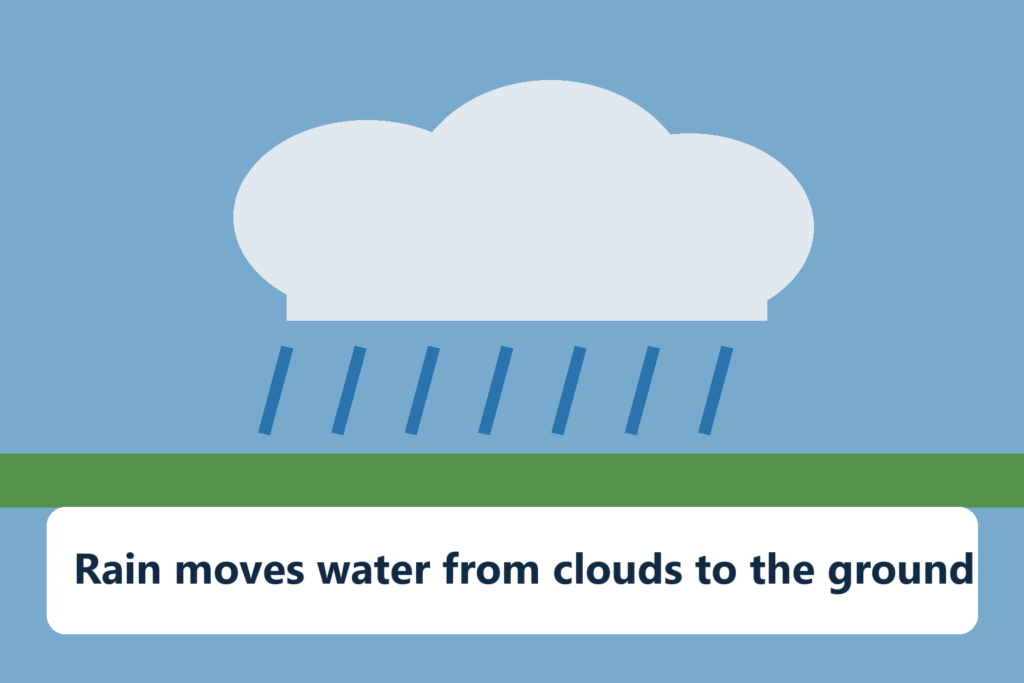
Why does it rain? It rains when water droplets in clouds grow heavy enough to fall to the ground. The process is part of the water cycle, which continually moves water between the surface, air, and clouds.
The main cause
Sunlight warms oceans, lakes, rivers, soil, and plants. Some water changes into invisible vapor and rises with warm air. Higher in the atmosphere, temperatures are usually cooler. The vapor loses heat and condenses around tiny particles such as dust, salt, or smoke.
Condensation creates cloud droplets. A cloud can contain millions of droplets that are so small air currents keep them floating. Rain begins only after those droplets combine or interact with ice crystals and become large enough for gravity to win.
The water cycle
Evaporation and plant transpiration add moisture to the air. Condensation forms clouds, and precipitation returns water to Earth as rain, snow, sleet, or hail. Water that reaches the ground may soak into soil, flow into streams, or evaporate again.
This cycle explains why rain can fall far from the ocean where the original water evaporated. Winds carry moist air across continents, and mountains can force that air upward, helping clouds form.
How clouds make drops
In warm clouds, tiny droplets bump into one another and merge into larger drops. In colder clouds, ice crystals can grow while nearby supercooled droplets evaporate. The crystals may melt into rain as they fall through warmer air.
Not every drop reaches the ground. Dry air below a cloud can evaporate falling water, creating streaks called virga. If the air stays humid, more of the precipitation survives to become measurable rainfall.
Rain begins when tiny cloud droplets or ice particles grow large enough that gravity pulls them downward faster than rising air can keep them suspended.
Why rain varies
Rainfall changes with cloud height, temperature, wind, humidity, and terrain. Drizzle has very small drops and often falls from low layered clouds. Showers can start and stop quickly. Large storm clouds may release intense rain along with lightning, gusty winds, or hail.
Meteorologists watch how clouds and weather systems move, then combine radar, satellite observations, surface measurements, and forecast models. The percentage in a rain forecast is about the chance of measurable precipitation at a location; it does not tell you how much rain will fall or whether nearby neighborhoods will receive the same amount.
Why rain matters
Rain returns freshwater to soils, streams, reservoirs, and underground aquifers. That water supports plant growth and supplies ecosystems and communities. Long dry periods can lead to drought, while intense rainfall can overwhelm drainage, wash away soil, and raise flood risk.
When asking why does it rain, remember that rain is not random water falling from a clear sky. It is the visible part of a repeating system powered mainly by sunlight and gravity.
For the next step, read What is rain? and How does rain help plants?.
Rain can begin when a front lifts warm, moist air, when mountains force air upward, or when strong heating makes air rise quickly. Each setting changes the cloud structure and the timing of the precipitation. That is why one neighborhood may receive a downpour while a nearby area stays dry. Ground temperature and wind also affect whether falling drops evaporate before reaching the surface. Learning why does it rain connects a simple daily observation with atmospheric pressure, humidity, and motion.
These differences are why rain gauges and radar are both useful: each measures a different part of the same changing weather system.
That same system shapes everyday forecasts today.
Related questions
- Where does rain come from?
- What makes clouds form?
- Why does rain sometimes turn into snow?
- How is rainfall measured?