Table of contents
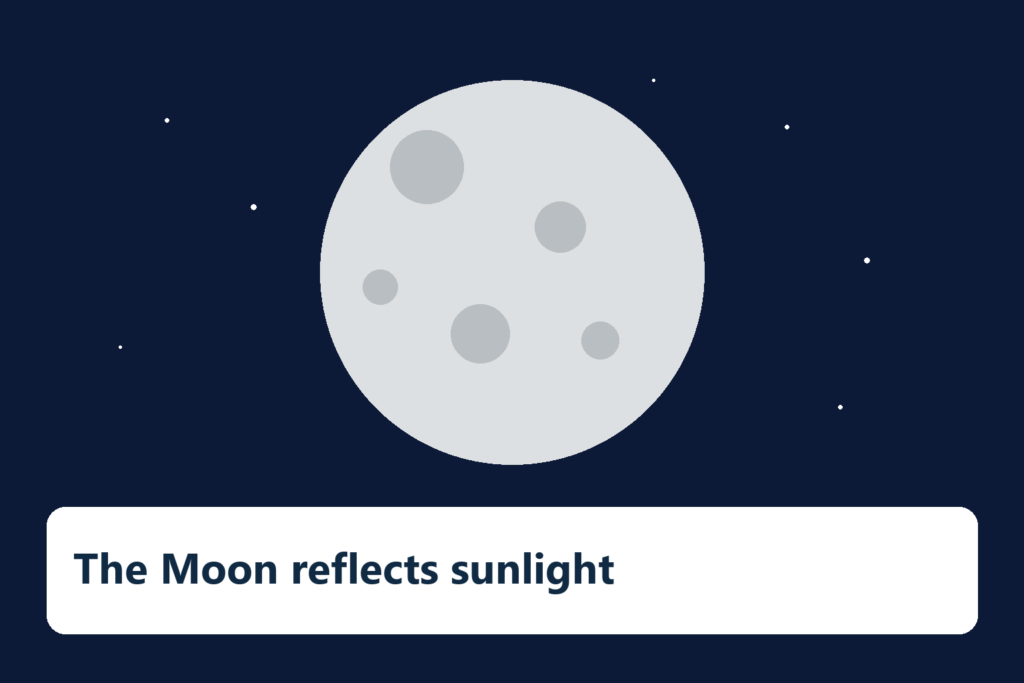
Why does the Moon shine? The Moon shines because its surface reflects light from the Sun toward Earth. It does not produce its own visible light like a star. The amount we see depends on the Moon’s position as it orbits Earth.
Reflected sunlight
Sunlight falls on half of the Moon at any moment. The Moon’s dusty rock reflects some of that light, and our eyes interpret the illuminated portion as moonlight. The Moon is much darker than white paper, but its large size makes it appear bright against a night sky.
When sunlight hits the Moon’s surface, rocks and soil scatter the light in many directions. Only a small fraction travels toward Earth. The Moon can still cast faint shadows in a dark location during a full Moon.
Why brightness changes
As the Moon moves around Earth, we see different proportions of its sunlit half. During a new Moon, the bright side faces mostly away from us. During a full Moon, the near side faces the Sun and we see nearly the entire illuminated half. Between those points are crescent, quarter, and gibbous phases.
The Moon’s phase is not caused by Earth’s shadow. Earth’s shadow falls on the Moon only during a lunar eclipse, when the Sun, Earth, and Moon line up closely. Most months the alignment is slightly off because the Moon’s orbit is tilted.
Moonlight and eclipses
A lunar eclipse can make the Moon look reddish because Earth’s atmosphere bends and filters sunlight into the shadow. During a solar eclipse, the Moon blocks part of the Sun from a particular location on Earth. These events demonstrate that the Moon is reflecting sunlight rather than glowing by itself.
Common questions
Is moonlight cold? Moonlight is reflected sunlight and carries a tiny amount of energy, so it does not warm objects noticeably. Why is a full Moon not always the same size? The orbit is slightly elliptical, so distance changes a little. Can you see the Moon in daytime? Yes, its position often places it above the horizon during daylight.
For related reading, see What is the Moon? and Why does the Moon look like it changes shape?.
When someone asks why does the Moon shine, the key distinction is between making light and reflecting it. The Moon reflects sunlight, and its orbit changes how much of that reflection we see.
That is why does the Moon shine has a simple, testable answer: sunlight reaches the lunar surface and bounces toward observers on Earth.
Why moonlight can look so bright
The Moon reflects only a modest fraction of the sunlight that reaches it, but it can still appear bright because it covers a noticeable patch of dark sky. Human vision also becomes more sensitive in low light, so the contrast between the Moon and the night sky makes moonlight seem stronger than its actual energy level suggests.
The surface is not equally bright everywhere. Fresh crater material can reflect more light than older, darker plains, and the viewing angle changes how shadows fall across mountains and craters. Those details are why binoculars can reveal so much texture even though the Moon is shining only by reflected sunlight.
Why moonlight changes during the month
A crescent Moon can look dramatically dimmer than a full Moon because much less of the sunlit surface is facing us. Brightness also depends on the angles between the Sun, Moon, and observer. Near full Moon, shadows on the lunar surface become shorter, so more illuminated ground contributes to the bright disk we see from Earth.