Table of contents
Where does rain come from? Most of its water first enters the air through evaporation from oceans, lakes, rivers, and wet ground, with plants adding moisture through transpiration. Winds can then carry that vapor far from its original source before it becomes rain.
The main cause
Most rain begins with water that evaporated from oceans, lakes, rivers, wet soil, and plant leaves. That vapor can travel long distances before cooling and becoming cloud droplets, so the rain falling over your town may have started as water from a completely different region.
Once transported moisture cools enough, it condenses into a cloud. The cloud is a temporary stop in the journey: tiny droplets or ice particles must grow before water can leave the cloud and begin falling toward the ground.
The water cycle
The source of atmospheric moisture is not limited to open water. Plants release water vapor through transpiration, and wet ground also contributes. That means a single storm can contain moisture gathered from several parts of the landscape.
Winds act like a delivery system for atmospheric moisture. Air can carry water vapor inland for hundreds or thousands of miles, and mountain ranges often force that air upward, where cooling makes clouds and precipitation more likely.
Much of the water that later falls as rain first enters the air through evaporation from oceans, lakes, rivers, and soil, along with water released by plants.
How clouds make drops
Whether that cloud water reaches you as rain depends on temperature along its path. Ice and snow formed higher in a cloud can melt before reaching the surface, while liquid droplets in warmer clouds can grow by colliding with one another.
Some water starts falling but never completes the trip. In dry air beneath a cloud, drops can evaporate on the way down. Visible streaks that fade before reaching the ground are called virga.
Why rain varies
Where rain finally falls is controlled by moving air, terrain, humidity, and the life of the storm itself. A cloud may release moisture over one neighborhood while nearby places stay dry because the cloud or wind pattern shifts.
Meteorologists track this moving moisture with satellites, radar, weather observations, and computer models. Those tools help estimate where a storm is carrying water and where conditions may cause it to fall.
Why rain matters
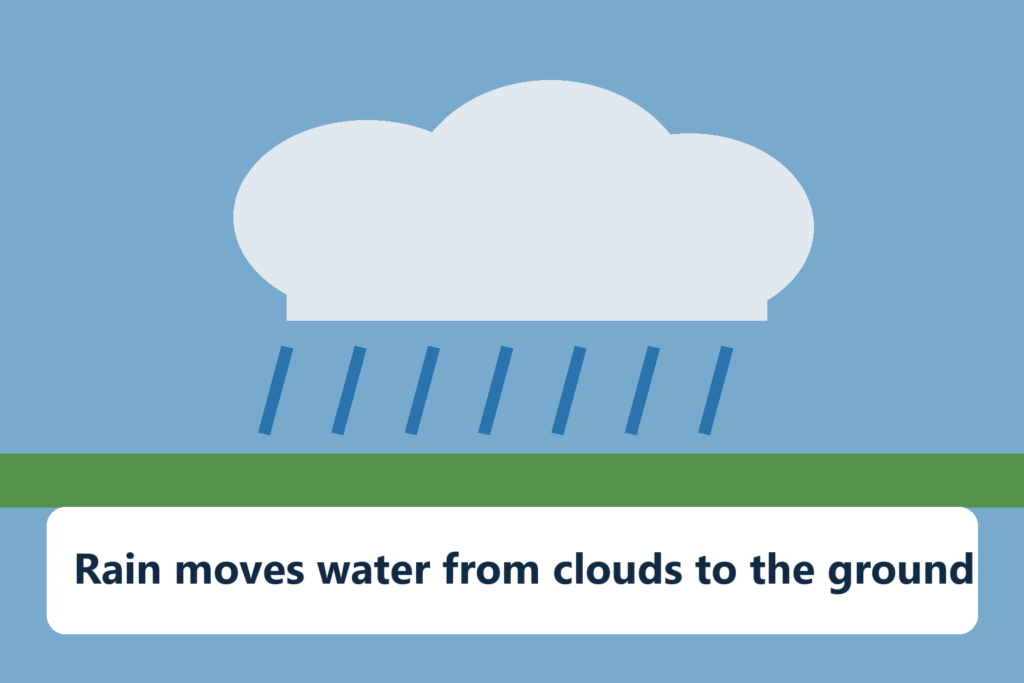
After rain reaches the ground, some water runs into streams and rivers, some soaks into soil, and some moves deeper to recharge groundwater. Part of it eventually returns to the atmosphere through evaporation and plant transpiration, continuing the water cycle.
Rain therefore has both a source and a route. Sunlight helps move water into the atmosphere, winds transport that moisture, and gravity eventually brings condensed water back toward the surface.
For the next step, read What is rain? and How does rain help plants?.
The place where rain finally falls may be far from where its moisture entered the air. Weather fronts can carry humid air into a region, mountains can redirect and lift it, and local heating can build clouds from moisture already nearby. Following that path—from surface water to vapor, cloud, and precipitation—is the key to understanding where rain comes from.
Radar watches precipitation across a broad area, while a rain gauge records the water that actually reaches one location. Together they help meteorologists trace where a storm delivered its moisture.
That same system shapes everyday forecasts today.
Related questions
- Where does rain come from?
- What makes clouds form?
- Why does rain sometimes turn into snow?
- How is rainfall measured?