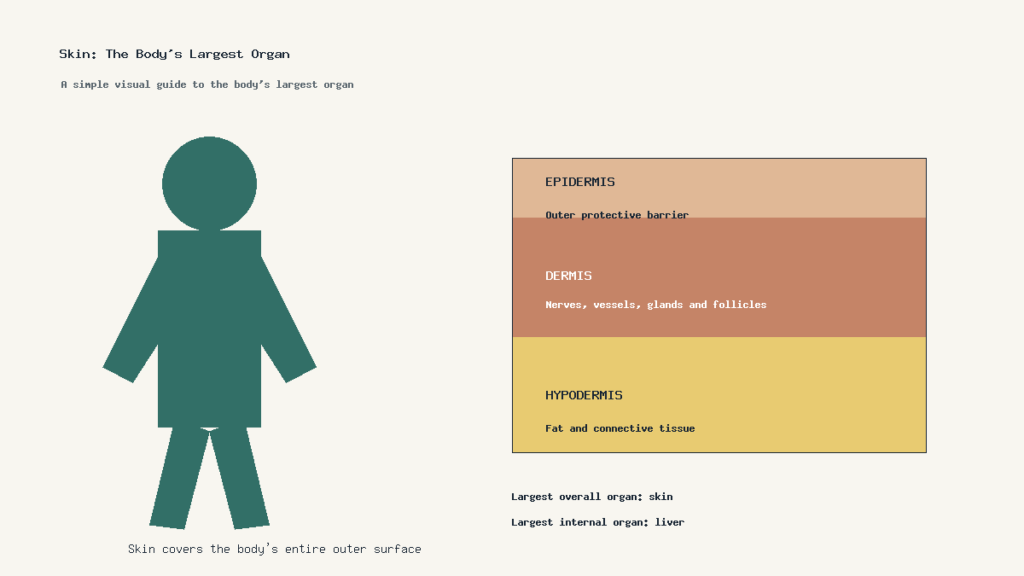
Largest organ in human body: the skin. The skin is the largest organ in the human body. It covers the entire outside of your body and acts as a protective barrier between your internal tissues and the environment. If you mean the largest internal organ, that is the liver.
The answer can be surprising because people often picture organs as structures hidden inside the chest or abdomen. But an organ is a body structure made of tissues that work together for specific jobs, and skin clearly fits that definition.
Table of Contents
Why Is Skin the Largest Organ in Human Body?
Skin is much more than a covering. The National Library of Medicine describes it as the body’s largest primary protective organ. It contains several types of tissue and performs multiple jobs that are essential for keeping the body’s internal environment stable.
Because the largest organ in human body stretches across the body’s entire external surface, it also has an enormous surface area compared with other organs. Estimates vary with a person’s height and body mass, but an NCBI overview says adult skin can cover roughly 1.5 to 2 square meters and account for about one-seventh of body weight.
What Does the Skin Do?
The skin performs several jobs at the same time. Its most obvious role is protection, but that is only part of the story.
- Protection: It creates a physical barrier against germs, chemicals, ultraviolet light and physical damage.
- Temperature control: Blood flow and sweating help the body release or conserve heat.
- Sensation: Receptors in the skin help you detect touch, pressure, pain, heat and cold.
- Water balance: The skin limits excessive water loss to the environment.
- Immune defense: Skin participates in the body’s defenses against pathogens.
- Vitamin D production: Processes in the skin help begin vitamin D production when skin is exposed to ultraviolet B light.
What Are the Layers of the Skin?
Skin is commonly described in three main layers: the epidermis, dermis and hypodermis (subcutaneous tissue). Each contributes something different to the organ as a whole.
Epidermis
The epidermis is the outermost layer. It provides much of the barrier between your body and the outside world. It contains keratin-producing cells and melanocytes, which make the pigment melanin.
Dermis
The dermis sits underneath the epidermis. It contains connective tissue, nerves, blood vessels, hair follicles, sweat glands and oil glands. Many of the skin’s sensory and temperature-regulating functions depend on structures in this layer.
Hypodermis
The deepest layer is often called the hypodermis or subcutaneous tissue. It contains fat and connective tissue that help cushion and insulate the body.
What Is the Largest Internal Organ?
If someone asks for the largest organ inside the human body, the answer changes. The liver is the largest internal organ. Cleveland Clinic notes that the liver performs hundreds of important functions, including processing nutrients, filtering blood, producing bile and helping regulate energy stores.
That distinction explains why both “skin” and “liver” sometimes appear in answers to questions about the body’s largest organ: skin is the largest organ overall, while the liver is the largest internal organ.
Is Skin Really Heavier Than Every Other Organ?
Skin measurements depend on exactly which tissues researchers include and on the size of the person being measured. Still, medical references consistently identify skin as the body’s largest organ by overall extent, and some describe it as the heaviest as well. NCBI’s InformedHealth overview estimates skin can weigh roughly 3.5 to 10 kilograms (7.5 to 22 pounds), depending on height and body mass.
Why Does the Largest Organ Matter So Much?
Calling skin the largest organ in human body describes its scale, but being large is not what makes skin important. Its location does. Every day, the skin sits directly between the body’s delicate internal environment and sunlight, temperature changes, microbes, chemicals and physical contact. Damage to enough skin, such as severe burns, can therefore affect temperature control, fluid balance and protection from infection.
The body has many surprising structures and measurements. For another human-body question, see why fingers wrinkle in water, or browse more answers in our Human Body section.
Frequently Asked Questions
What is the largest organ in the human body?
The skin is the largest organ in the human body. It covers the body’s external surface and performs protective, sensory, temperature-regulating and other functions.
What is the largest internal organ?
The liver is the largest internal organ in the human body.
Is the skin one organ or many organs?
The skin is treated as one continuous organ. Different areas vary in thickness and specialization, but together they form the body’s integumentary covering.
The Short Answer
Skin is the largest organ in the human body. It surrounds the body, protects internal tissues, helps control temperature and water loss, and lets you sense the world around you. The liver takes the title when the question is limited to internal organs.