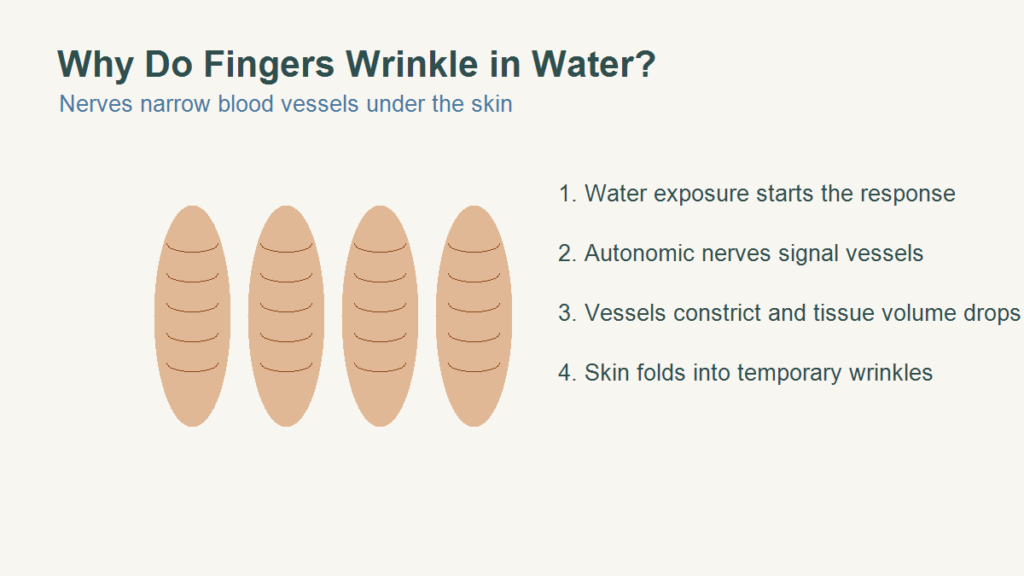
Why do fingers wrinkle in water? After several minutes in water, nerves in your fingers trigger blood vessels beneath the skin to narrow. That reduces the volume of tissue under the surface, causing the skin to fold into the familiar wrinkled or “pruney” pattern.
Scientists once thought the skin simply swelled because it absorbed water. Research now shows that finger wrinkling is largely controlled by the autonomic nervous system rather than simple soaking alone.
Table of Contents
Why Do Fingers Wrinkle in Water?
The best-supported explanation for why fingers wrinkle in water is nerve-controlled vasoconstriction. When the skin on your hands is immersed, your autonomic nervous system causes small blood vessels in the fingertips to constrict.
As those vessels narrow, the tissue beneath the skin loses a little volume. The outer skin then buckles into ridges and valleys. This is why the pattern can appear even though the skin itself has not simply “filled up” like a sponge.
What Causes Pruney Fingers?
Water exposure starts the process, but the nervous system does the important work. Medical researchers have known for decades that people with certain nerve injuries may not develop normal water-induced wrinkling in the affected fingers.
That finding helped show that intact sympathetic nerves are required. The same part of the nervous system helps control blood vessel diameter, sweating and other automatic body functions.
Why Do Fingers and Toes Wrinkle Most?
The effect is most obvious on the thick, hairless skin of the fingers, palms, toes and soles. These areas have specialized skin structure and dense nerve and blood-vessel networks.
Other parts of your body can absorb water at the surface, but they do not usually show the same dramatic ridge pattern.
Does Wrinkling Help You Grip Wet Objects?
One intriguing idea is that wrinkles may improve grip in wet conditions by channeling water away from the contact surface, somewhat like tread on a tire. Some experiments have found better handling of wet objects with wrinkled fingers, while other studies have found little or no advantage.
So the evolutionary purpose is still debated. The nerve-controlled mechanism is well established, but the idea that wrinkling evolved specifically to improve grip is not settled science.
How Long Does It Take for Fingers to Wrinkle?
Wrinkling usually begins after several minutes in water and becomes more obvious with longer immersion. The exact timing varies with water temperature, individual physiology and other factors.
Warm water often makes the effect appear sooner than cold water because blood flow and nerve responses differ with temperature.
Do Wrinkled Fingers Mean Your Skin Is Damaged?
Ordinary temporary wrinkling after a bath, shower or swim is normal. The skin usually smooths out after you dry off and blood vessels return to their usual state.
Persistent wrinkling when your hands have not been in water can have other causes, but that is different from normal water-induced wrinkling.
Frequently Asked Questions
Is wrinkling caused by skin absorbing water?
Not primarily. Water exposure starts the response, but the characteristic wrinkles depend mainly on nerve-controlled narrowing of blood vessels under the skin.
Why do toes wrinkle too?
Toes have similar thick, hairless skin and autonomic nerve control, so they show a comparable response to prolonged water exposure.
Do fingers wrinkle faster in hot water?
Often yes. Warm water can speed the response, although individual timing varies.
The Short Answer
Why do fingers wrinkle in water? Your autonomic nervous system makes small blood vessels in your fingertips constrict. The tissue underneath shrinks slightly, and the skin folds into wrinkles.
For another Human Body question, see what the largest organ in the human body is and how many ribs humans have, or browse the Human Body section.