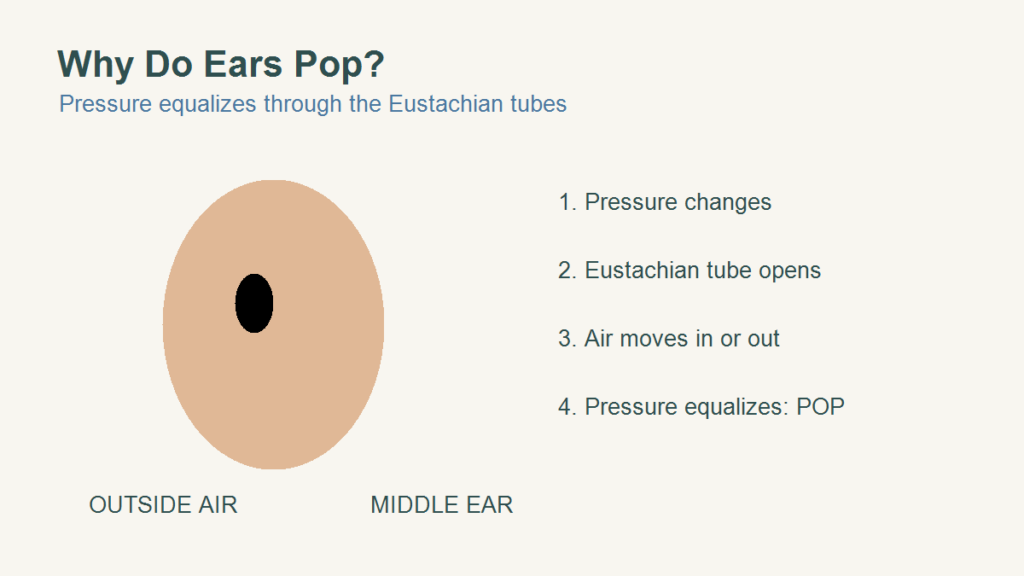
Why do ears pop? Your ears pop when the air pressure in your middle ear changes and your Eustachian tubes open to equalize that pressure with the air around you. The familiar pop can happen during flights, elevator rides, driving through hills, swallowing, yawning, or when congestion temporarily blocks the tubes.
The Eustachian tubes are narrow passages that connect the middle ear to the back of the nose and throat. They usually stay closed and open briefly when you swallow or yawn.
Table of Contents
Why Do Ears Pop?
The pressure on both sides of your eardrum works best when it is roughly equal. The outside of the eardrum is exposed to the surrounding air through the ear canal, while the middle ear is an air-filled space behind the eardrum.
Your Eustachian tubes help keep those pressures balanced. When the pressure difference becomes large enough, or when you swallow or yawn, a tube can open suddenly. Air moves in or out of the middle ear, and you may hear or feel a pop.
What Is Happening Inside Your Ear?
The eardrum is a thin membrane that vibrates when sound waves reach it. If air pressure is different on the two sides of the eardrum, the membrane can stretch inward or outward slightly. That can create a feeling of fullness, muffled hearing, or pressure.
When the Eustachian tube opens, air can move between the middle ear and the throat area. The pressure equalizes, the eardrum returns closer to its normal position, and the pressure sensation often disappears.
Why Do Ears Pop on Planes and Hills?
Air pressure decreases as altitude increases and rises again as altitude decreases. During airplane takeoff, landing, mountain driving, or fast elevator travel, the surrounding air pressure can change faster than the pressure inside your middle ear.
Your ears pop when the Eustachian tubes catch up with that change. Swallowing, chewing, or yawning can help because those actions encourage the tubes to open.
Why Does Swallowing Make Ears Pop?
Muscles in the throat help open the Eustachian tubes during swallowing. That is why taking a sip of water or chewing gum can make pressure in your ears suddenly release.
Yawning can have a similar effect. The movement changes the shape of tissues around the tube opening and can briefly let air pass through.
Why Do Ears Sometimes Feel Blocked?
Colds, allergies, sinus inflammation, and other swelling around the nose and throat can make it harder for the Eustachian tubes to open. When that happens, pressure may stay unequal longer and the ear can feel plugged.
Most brief pressure changes are ordinary, especially during travel. Persistent pain, drainage, significant hearing loss, or pressure that does not clear can have other causes and is worth discussing with a healthcare professional.
Why Do Some Ears Pop More Easily Than Others?
Eustachian tube size and function vary from person to person. Children have shorter, more horizontal tubes than adults, which is one reason middle-ear pressure and fluid problems are more common in children.
Congestion also matters. Someone with a cold or seasonal allergies may notice much more popping because swollen tissues can make the tubes open less smoothly.
Frequently Asked Questions
Is ear popping normal?
Occasional popping during swallowing, yawning, flying, or altitude changes is usually part of normal pressure equalization.
Why do ears pop when you yawn?
Yawning activates muscles around the Eustachian tubes and can make them open briefly, allowing air pressure to equalize.
Why do ears pop when you swallow?
Swallowing helps open the Eustachian tubes, letting air move between the middle ear and the back of the throat.
The Short Answer
Why do ears pop? The sound and sensation usually happen when your Eustachian tubes open and equalize air pressure on the two sides of your eardrum.
For more Human Body questions, read why fingers wrinkle in water, how many ribs humans have, or browse the Human Body section.