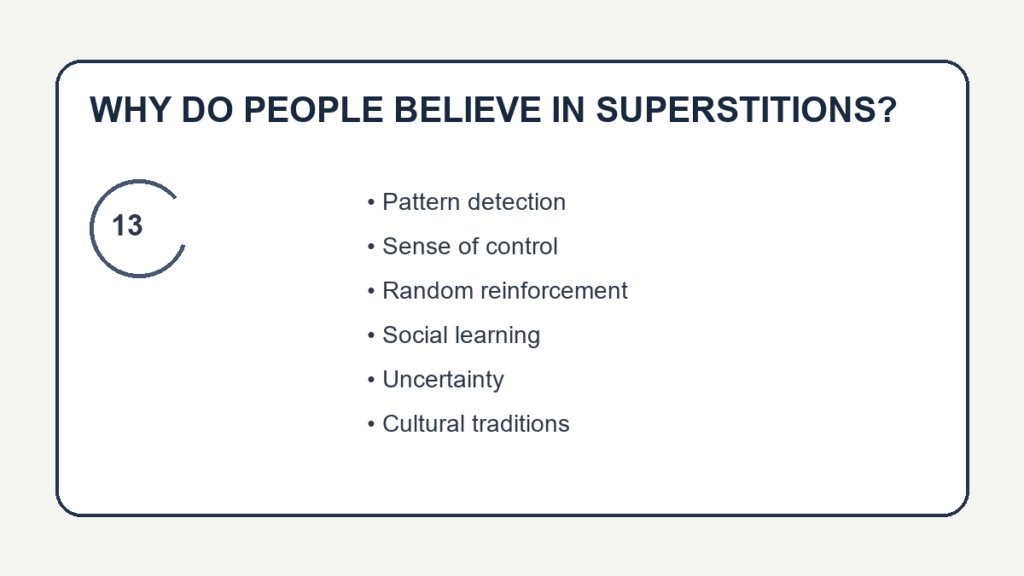
Why do people believe in superstitions? Superstitions can feel convincing because the human mind is very good at spotting patterns, connecting actions with outcomes, learning from other people, and looking for control when events are uncertain. Research suggests that superstition is not caused by one single trait. It can grow from coincidence, social learning, cultural traditions, stress, uncertainty, and the way people remember successes more easily than failures.
Table of Contents
Why Do People Believe in Superstitions? The Short Answer
People believe in superstitions because ordinary learning and reasoning processes can create a convincing connection between two events even when the connection is accidental. If someone wears a particular shirt and then wins, knocks on wood and then avoids bad news, or repeats a ritual before a successful performance, the sequence can feel meaningful.
That feeling can be strengthened when the ritual reduces anxiety, is shared by family or teammates, or becomes part of a familiar cultural tradition.
1. Coincidences Can Look Like Meaningful Patterns
Why do people believe in superstitions? Pattern detection is one reason. Humans are built to search for patterns. That ability is useful because real patterns help us predict danger, food, weather, other people, and cause-and-effect relationships. But the same system can sometimes detect a relationship where none exists.
Laboratory research has shown that people can perceive control over outcomes that are actually independent of their actions. One study found that stronger superstition was associated with stronger perception of illusory control in a task where button presses did not truly cause the outcome.
Once a coincidence feels meaningful, it can become the beginning of a superstition.
2. Superstitions Can Create a Sense of Control
Why do people believe in superstitions? One reason is that chance is uncomfortable. In sports, exams, health scares, travel, relationships, and other uncertain situations, people often want something they can do.
Research on ritual efficacy found that making randomness more mentally salient increased how effective people thought rituals would be. Superstitions can therefore provide a sense of order when the real outcome is partly or entirely outside a person’s control.
The ritual may not change the external event, but it can change how predictable or manageable the situation feels.
3. Random Success Can Reinforce a Ritual
Suppose someone taps a doorway twice before an interview and then gets the job. The tapping did not necessarily cause the result, but the successful outcome came immediately after the ritual. That timing can make the connection feel real.
Experiments on superstitious inference show that accidental reinforcement can strengthen unnecessary actions. When rewards happen near a behavior, people may begin repeating the behavior even when the reward is actually random.
Over time, the ritual can become more elaborate because every lucky outcome seems to confirm it.
4. We Learn Superstitions From Other People
Why do people believe in superstitions? Social learning is another reason. Superstitions are often social. Children hear them from parents and grandparents. Athletes copy teammates. Friends pass along rituals. Communities preserve beliefs about lucky numbers, unlucky dates, charms, signs, and taboos.
A participant-replacement experiment found that superstitious behavior could be transmitted by observation. People who watched another person behave superstitiously were more likely to copy the behavior and develop an inflated sense of control over the outcome.
This helps explain why a superstition can survive even when nobody remembers where it started.
5. Uncertainty Makes Rituals More Appealing
Why do people believe in superstitions? Uncertainty matters too. Superstitions often become more noticeable when people feel that important outcomes are unpredictable. Research during the COVID-19 pandemic examined how perceived risk, loss of control, and superstitious belief were related during a period of unusual uncertainty.
Recent research has also linked superstition endorsement with factors such as intolerance of uncertainty, thinking style, and experienced stress. The relationships are not identical for everyone, but uncertainty appears to be an important part of the picture.
A ritual can offer a small feeling of structure when the larger situation does not offer much control.
6. Memory Can Favor the Times a Superstition “Worked”
Why do people believe in superstitions? Memory can reinforce them. If someone believes Friday the 13th is unlucky, a bad event that happens on that date may stand out. An ordinary day on Friday the 13th is easier to forget. The same thing can happen with lucky shirts, charms, numbers, or pre-game routines.
This selective attention can make the superstition feel more accurate than it is. People may also reinterpret ambiguous events in ways that fit what they already expect.
Similar reasoning processes appear in other unusual beliefs. See Why Do People Believe in Conspiracy Theories? for another example of how pattern detection and expectations can shape interpretation.
7. Culture Keeps Superstitions Alive
Many superstitions are not private inventions. They are inherited cultural stories. Ideas about broken mirrors, black cats, lucky numbers, unlucky numbers, knocking on wood, or avoiding certain actions can be repeated for generations.
Because they are familiar, culturally shared superstitions often feel less strange than a brand-new claim. Repetition gives them a ready-made explanation and a place in everyday conversation.
Culture also affects which beliefs feel plausible. The same unusual event can be interpreted very differently in different communities. That is also true for beliefs about ghosts and astrology.
Do Superstitions Actually Work?
There is an important difference between a ritual affecting how a person feels and the ritual controlling an outside random event. A familiar routine may reduce nervousness, increase confidence, or help someone focus. Those psychological effects can be real.
But evidence that a ritual changes the probability of an unrelated random event requires more than a memorable coincidence. A useful test asks whether the claimed effect appears reliably when the ritual is compared with a control condition and whether the result can be repeated independently.
Without that kind of evidence, a lucky outcome after a ritual does not establish that the ritual caused the outcome.
Frequently Asked Questions
Are superstitions irrational?
Some superstitious beliefs involve causal claims that are not supported by evidence, but the psychological processes behind them are ordinary human processes such as learning, pattern detection, memory, and social influence.
Why are athletes often superstitious?
Athletic performance combines skill with uncertainty. Repeated routines can reduce anxiety and create a sense of consistency, making sports a natural setting for superstition.
Can a superstition help even if it is not true?
A ritual may help someone feel calmer or more confident. That does not mean the ritual changes an unrelated external event such as a lottery drawing or random bounce.
Why do superstitions survive for generations?
They are easy to teach, easy to remember, and often connected to emotionally important events. Social learning can preserve them even when their original explanation is forgotten.
Is superstition the same as religion?
No. Researchers usually study superstition as a distinct category involving beliefs about luck, signs, rituals, or causal relationships. Religious belief is broader and cannot be reduced to superstition.
Why Do People Believe in Superstitions? Bottom Line
Why do people believe in superstitions? Because coincidences can look meaningful, rituals can provide a sense of control, random rewards can reinforce behavior, other people transmit beliefs, and uncertainty makes simple explanations appealing.
The experience can feel convincing even when the causal link has not been demonstrated. The evidence-first question is not whether the ritual feels meaningful, but whether it reliably changes the outcome it is claimed to control.
Sources
- Griffiths et al. — Superstition Predicts Perception of Illusory Control
- Behavior and Illusions: Social Transmission of Superstitious Behavior
- Fluke et al. — Methodological and Theoretical Improvements in the Study of Superstitious Beliefs and Behaviour
- Searching for Control: Priming Randomness Increases Evaluation of Ritual Efficacy
- Rudski — Effect of Delay of Reinforcement on Superstitious Inferences
- Superstitious Beliefs, Locus of Control, and Feeling at Risk
- Caspi et al. — Psychological Determinants of Superstition Endorsement