Table of contents
Do spiders sleep?
Do spiders sleep? Many spiders enter a sleep-like resting state, but scientists are still studying exactly how it compares with human sleep. A resting spider may become motionless, lower its activity, and conserve energy. Because spiders have no eyelids, their eyes stay open even when they are resting.
How do spiders rest?
A spider’s daily activity depends on its species, temperature, light, prey, and surroundings. During a quiet period, it may stay in a retreat, hang in a web, or hold its legs close to its body. Its movements and responses can slow, but it may still detect vibrations, air movement, or nearby danger.
Researchers use more than stillness to decide whether an animal sleeps. They look for reduced responsiveness, a regular resting pattern, changes in body activity, and sometimes a rebound—more rest after the animal has been kept awake. For spiders, evidence for a sleep-like state is growing, but it does not mean every species has sleep identical to ours.
What about jumping spiders?
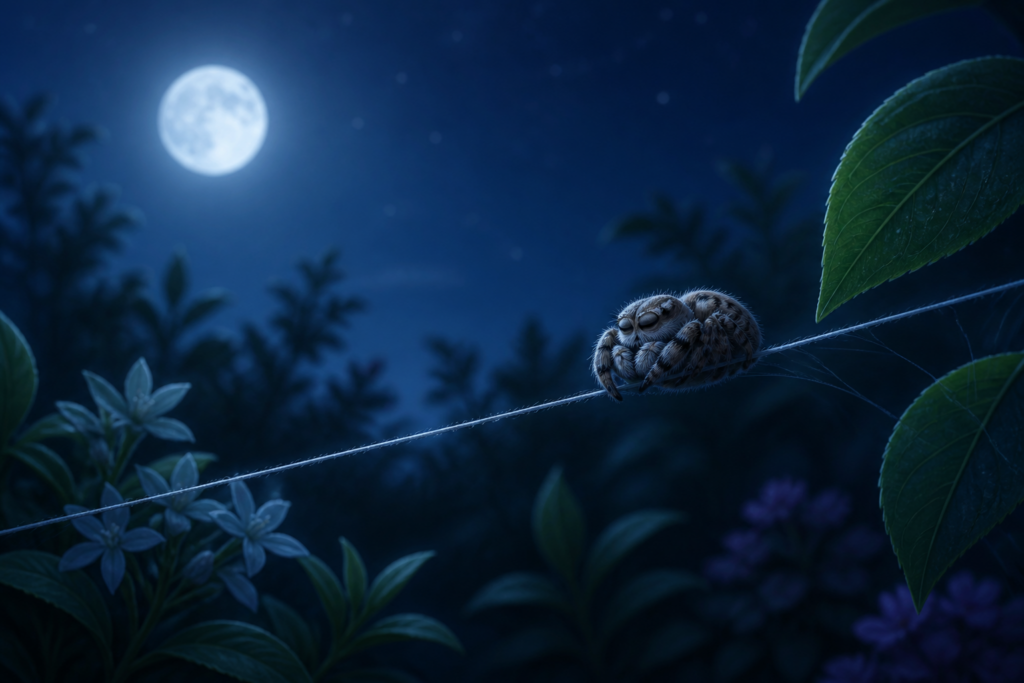
Young jumping spiders have provided some of the most interesting observations. At night, they may hang from a silk line with their legs curled and show bursts of movement in their bodies and eyes. These movements resemble rapid-eye-movement, or REM, sleep in mammals. Scientists describe the behavior as REM-like rather than claiming that spiders dream exactly as people do.
Jumping spiders are visual hunters that normally move around during the day. A quiet nighttime period may help them save energy and recover from activity. Web-building species can have different schedules, so one spider’s resting pattern should not be used to describe every spider.
Can spiders dream?
We cannot know whether spiders have dreams because we cannot ask them about private experiences. The eye and leg movements observed in some jumping spiders suggest a sleep-like state, but they do not prove a dream. Careful language matters: scientists can report what the animals do without adding a human interpretation that has not been demonstrated.
Why are some spiders active at night?
Many spiders are nocturnal because darkness can help them avoid birds and other daytime predators. Night air may also be cooler and less dry. A web-building spider may repair silk, rebuild a damaged web, or wait for insects while it is dark. Other spiders hunt actively after sunset, then rest in a hidden place during the day.
Do people swallow spiders in their sleep?
The familiar claim that people swallow several spiders every year in their sleep is a myth. Spiders usually avoid large, breathing animals because vibrations and movement signal danger. A spider could accidentally wander near a sleeping person, but there is no scientific basis for a standard number of spiders being swallowed.
How can you tell a spider is resting?
Look for a spider that remains in one place, responds slowly, and holds its legs in a relaxed or curled position. Do not touch or disturb it. A motionless spider may also be waiting for prey, hiding from danger, or affected by cold, so appearance alone cannot prove sleep.
For a related topic, read Why do spiders make webs? and How do spiders make silk?.
Resting also gives a spider time to manage energy carefully. Making silk, growing, hunting, and producing eggs all require resources, so a quiet period can be useful even when it is not identical to mammal sleep. Scientists are comparing more species to learn how widespread sleep-like behavior is among spiders and other invertebrates.
Related questions
- Do spiders dream?
- How long do spiders rest?
- Why do spiders hang upside down?
- Are spiders active at night?
- Do insects sleep?